In luxury hospitality design, mirrors are no longer used only for checking appearance. They have become an important architectural and decorative element that influences how guests perceive space, lighting, materials, and overall hotel quality. From reception walls and elevator lobbies to guest rooms, corridors, restaurants, and luxury suites, reflective surfaces can create depth, improve light distribution, and establish a premium visual identity.
For hotel developers, architects, interior designers, contractors, and FF&E procurement teams, one important question is whether to choose hotel mirror panels or traditional glass mirrors.
At first glance, both products can provide a reflective finish. However, their differences become more obvious when considering large-area decoration, installation, customization, safety, weight, maintenance, project efficiency, and overall design flexibility.
Hotel mirror panels can be produced in different materials and finishes, including PVC-based mirror panels, acrylic mirror panels, aluminum composite mirror panels, stainless steel mirror panels, and other decorative composite solutions. Traditional mirrors, by comparison, generally use silvered or aluminum-coated glass and remain popular where optical clarity is the primary requirement.
For luxury hotel projects, the better choice depends on the application. Traditional mirrors remain excellent for applications requiring highly accurate reflection, while decorative hotel mirror panels can offer significant advantages for large-area wall decoration, feature walls, columns, corridors, and other architectural surfaces.
As a professional Chinese decorative wall panel manufacturer, إيسث إيدج supplies mirror panel solutions for international hospitality and commercial interior projects, with support for customization, bulk orders, OEM/ODM production, and project-based procurement.
This article compares hotel mirror panels with traditional mirrors and explains which solution is more suitable for luxury interiors.
What Are Hotel Mirror Panels?
Hotel mirror panels are decorative architectural panels designed to create a mirror-like or highly reflective surface on interior walls, ceilings, columns, furniture, reception areas, and other commercial spaces.
Unlike a conventional mirror that primarily consists of glass with a reflective coating, mirror panels can use different substrates depending on the required performance, appearance, weight, and budget.
Common types include:
PVC mirror panels
Acrylic mirror panels
Aluminum composite mirror panels
Stainless steel mirror panels
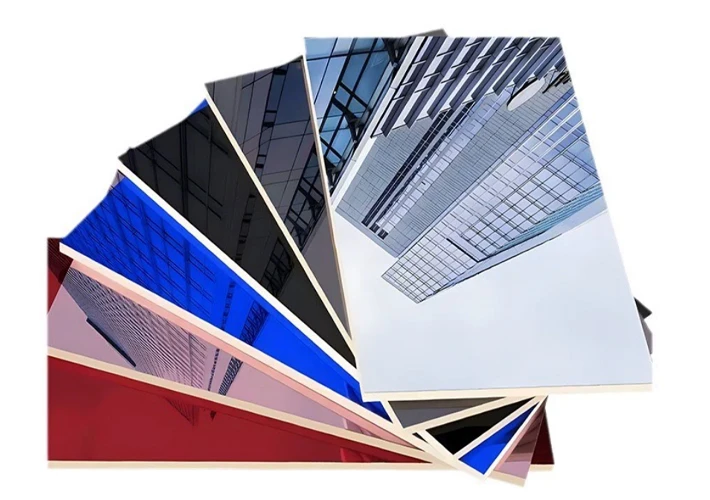
Decorative colored mirror panels
Black mirror panels
Gold mirror panels
Champagne mirror panels
Smoky grey mirror panels
AesthEdge's hotel mirror panel solutions are designed specifically for decorative and hospitality applications. Different materials can be selected according to the project's design concept, installation requirements, and application environment.
For example, acrylic and PVC mirror panels can be useful when lightweight construction and easy fabrication are important. Stainless steel mirror panels can provide greater durability in demanding commercial environments, while decorative colored finishes can create distinctive luxury aesthetics.
Modern hotel mirror panels are particularly useful for creating large decorative surfaces rather than simply functioning as personal mirrors.
They can be used on:
Hotel lobby feature walls
Reception backgrounds
Elevator surrounds
Hotel corridors
Restaurant walls
Banquet halls
Guest room feature walls
VIP lounges
Bar interiors
Columns
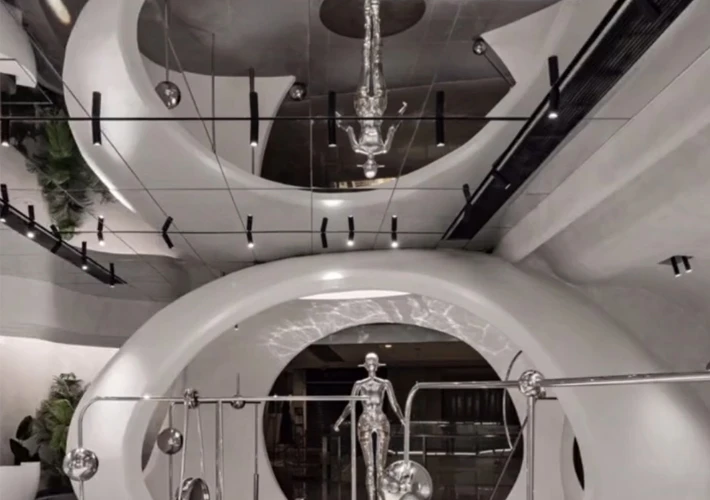
Ceiling decorations
Furniture and cabinetry
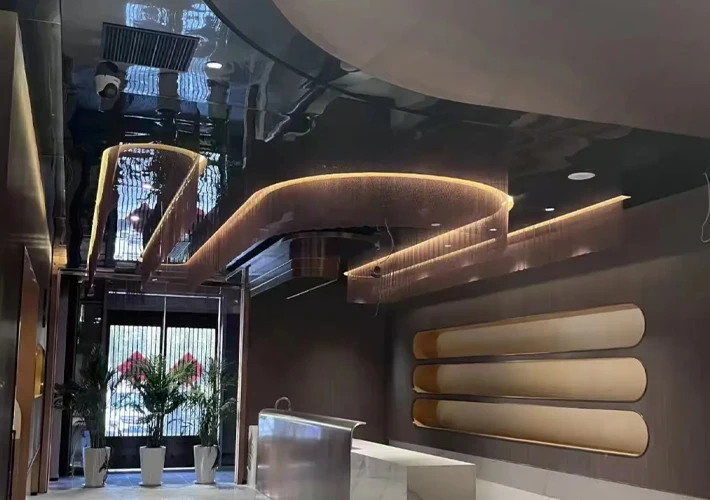
AesthEdge's existing hospitality applications include reception areas, hallways, elevator entrances, decorative ceilings, and other five-star hotel environments.
Hotel Mirror Panels vs Traditional Mirrors: Key Differences
The most useful way to compare the two products is to look beyond appearance.
ميزة
Hotel Mirror Panels
Traditional Glass Mirrors
Reflective appearance
Excellent for decorative applications
Excellent, especially for accurate reflection
وزن
Generally lighter depending on material
Relatively heavy
Breakage risk
Lower for many non-glass solutions
Higher because glass can break
Large-area installation
Convenient
More difficult
Cutting/customization
Flexible
Requires glass processing
تثبيت
Relatively easy for many panel systems
Requires careful handling
Design colors
Wide range
Mainly silver unless specially processed
Decorative applications
ممتاز
ممتاز
Bathroom vanity use
Depends on material
Excellent when properly specified
Large feature walls
Very suitable
Possible but more demanding
Complex shapes
Easy with suitable panel materials
More difficult
Transportation
Generally easier for lightweight panels
أكثر تطلبا
صيانة
Generally easy
Easy, but glass edges/backing require protection
Project efficiency
High for large decorative areas
معتدل
Optical clarity
Depends on panel material
Usually superior
The important point is that hotel mirror panels are not necessarily intended to replace every traditional mirror.
Instead, they provide an alternative when the design objective is to create a reflective architectural surface.
For example, a guest bathroom vanity may still benefit from a high-quality traditional glass mirror, while a 20-meter-long hotel corridor may be better suited to decorative mirror panels.
This distinction is important for hotel procurement.
Why Are Mirror Panels Popular in Luxury Hotel Interiors?
Luxury hospitality spaces depend heavily on visual atmosphere.
Guests form impressions within seconds of entering a lobby, walking through a corridor, or entering a restaurant. Materials that reflect light and surrounding architecture can make the interior appear more spacious and visually sophisticated.
Mirror panels provide several design advantages.
1. They Create a Sense of Space
Reflection can make relatively compact areas appear larger.
This is especially useful in:
Narrow corridors
Elevator lobbies
Small reception areas
Boutique hotel rooms
Compact restaurants
Guest room entrances
A reflective wall can visually extend the surrounding architecture and create greater depth.
AesthEdge notes that mirror panels can be used in narrow hallways, elevator waiting areas, reception backdrops, and VIP entrances to enhance perceived openness.
2. They Enhance Lighting Effects
Lighting is one of the most important elements in luxury hotel design.
Hotels commonly use:
LED strips
Pendant lights
Wall sconces
Chandeliers
Cove lighting
Decorative spotlights
Reflective panels can multiply the visual effect of these lighting systems.
For example, a champagne mirror wall combined with warm LED lighting can create a soft luxury atmosphere, while a black mirror panel combined with directional lighting can create a more dramatic appearance.
3. They Create Strong Feature Walls
Traditional wall materials such as paint and wallpaper can create attractive backgrounds, but reflective panels can produce a much stronger visual focal point.
A hotel lobby might combine:
Marble + gold mirror panel + brushed metal + indirect LED lighting
to create a premium entrance feature.
Similarly, a restaurant might combine:
wood veneer + smoky grey mirror + brass trim
to achieve a contemporary luxury aesthetic.
4. They Support Multiple Design Styles
Mirror panels are not limited to classic luxury hotels.
Different finishes can support different concepts.
Gold mirror panels Suitable for classic luxury, five-star hotels, resorts, and high-end reception areas.
Champagne mirror panels Suitable for contemporary luxury and warm neutral interiors.
Smoky grey mirror panels Suitable for modern business hotels and minimalist interiors.
Black mirror panels Suitable for boutique hotels, VIP lounges, bars, and dramatic feature walls.
AesthEdge's hotel applications include gold, champagne, smoky grey, and black titanium-style finishes, allowing designers to coordinate reflective surfaces with marble, wood, metal, and lighting.
Advantages of Traditional Mirrors in Luxury Hotels
Although mirror panels offer many advantages, traditional mirrors remain an important material in hospitality projects.
Excellent Reflection Quality
For applications where guests need to see an accurate reflection, glass mirrors are difficult to replace.
Typical applications include:
Bathroom vanity mirrors
Full-length guest room mirrors
Dressing areas
Makeup areas
Wardrobes
Spa facilities
High-quality glass mirrors provide excellent optical clarity and a premium reflective appearance.
For luxury bathroom applications, commercial-grade mirror specifications can also include copper-free glass and appropriate back protection to improve resistance to moisture-related deterioration.
Premium Glass Appearance
There is still a perception of quality associated with genuine architectural glass.
Luxury hotel bathrooms often use large glass mirrors because they provide:
Clear reflection
Premium appearance
Long-term stability when properly specified
Compatibility with integrated lighting
Excellent color accuracy
For certain luxury projects, this visual quality is a priority.
Suitable for Vanity Applications
Traditional mirrors are especially appropriate where the main function is personal reflection.
For example:
Hotel bathroom + vanity + LED lighting + large glass mirror
The first application prioritizes optical performance and functionality, while the second prioritizes architectural appearance and installation efficiency.
When Are Hotel Mirror Panels Better Than Traditional Mirrors?
The answer becomes clearer when the project involves large decorative areas.
Large Hotel Feature Walls
Traditional glass mirrors become increasingly challenging as surface area increases.
Large glass sheets are heavy and require careful transportation, handling, cutting, and installation.
Decorative mirror panels can provide a lighter alternative depending on the substrate selected.
This can be particularly valuable for:
Lobby feature walls
Corridor walls
Reception backgrounds
Restaurant interiors
Banquet halls
Elevator surrounds
Mirror aluminum composite panels, for example, are promoted for applications where low weight, large surfaces, durability, and easier fabrication are important.
Complex Geometric Designs
Luxury interiors increasingly use geometric patterns instead of simple rectangular mirror walls.
Designers may specify:
Arched shapes
Vertical strips
Hexagonal patterns
Curved elements
Decorative frames
Mixed-size panels
Custom logos
Inlay patterns
Many decorative panel materials can be processed into different shapes more conveniently than thick glass.
Projects With Strict Installation Schedules
Hotel renovation projects often have limited construction windows.
Every additional installation step can affect the project schedule.
Lightweight decorative panels can potentially reduce handling complexity, especially when large areas need to be completed quickly.
This is one reason material selection should consider not only the purchase price but also:
Hotel corridors, elevator lobbies, reception areas, and public spaces experience constant traffic.
In these areas, designers need to consider impact resistance, maintenance, cleaning frequency, and replacement costs.
Some non-glass mirror panel solutions offer lower breakage risk than conventional glass, although the exact performance depends heavily on the substrate and product specification.
For hotel projects, the panel should therefore be selected according to the actual application rather than simply choosing the lowest-cost material.
Hotel Mirror Panels for Different Luxury Interior Applications
One major advantage of mirror panels is their versatility.
Hotel Lobby
The lobby is usually the first major visual touchpoint for guests.
Mirror panels can be used behind:
Reception counters
Hotel logos
Concierge desks
Decorative walls
Columns
A large reflective feature wall can visually enlarge the lobby while making decorative lighting more noticeable.
Hotel Corridors
Long corridors can sometimes appear repetitive.
Instead of covering the entire corridor with one material, designers can use mirror panels as vertical decorative strips or symmetrical sections.
This can break up long wall surfaces while creating depth.
AesthEdge specifically identifies vertical mirror strips, framed mirror panels, and geometric mirror layouts as suitable techniques for hotel corridors.
Elevator Lobby
Elevator areas are highly visible and experience heavy traffic.
Mirror stainless steel, black mirror, or other durable decorative mirror solutions can be combined with:
Stone
رخام
Metal
Wood
LED lighting
to create a premium elevator entrance.
Restaurants and Bars
Restaurants can use mirror panels to reflect decorative lighting, furniture, and architectural details.
Dark mirror finishes are especially effective for sophisticated restaurant and bar interiors.
Guest Rooms
Mirror panels can be incorporated into:
Wardrobe doors
TV walls
Headboard feature walls
Dressing areas
Decorative partitions
Furniture
However, for areas where guests need distortion-free personal reflection, a properly specified glass mirror may remain the better choice.
Banquet Halls
Banquet halls often require dramatic decorative materials.
Gold and champagne mirror panels can work particularly well with:
Chandeliers
Decorative ceilings
Ballroom lighting
Marble flooring
Metallic trim
The reflective surface can amplify the visual impact of the entire space.
How Should Hotel Buyers Choose Between Mirror Panels and Traditional Mirrors?
For hotel developers and procurement teams, the best solution is not simply "mirror panels are better" or "traditional mirrors are better."
The correct approach is to match the material to the application.
Choose Traditional Mirrors When:
Optical clarity is the highest priority
Guests need an accurate personal reflection
The product is primarily a bathroom vanity mirror
The design requires premium architectural glass
The application is relatively small
Glass weight is not a major concern
The project requires specialized mirror technology
Choose Hotel Mirror Panels When:
Large wall areas need reflective decoration
Low weight is important
Complex shapes or patterns are required
Fast installation is important
The project requires multiple colors
The design uses mirror as an architectural finish
The hotel needs strong customization
The application is a feature wall, corridor, lobby, or column
Consider a Combination
For many luxury hotel projects, the most practical solution is to use both materials.
For example:
Guest bathroom: traditional high-quality glass mirror
Lobby feature wall: decorative mirror panel
Corridor: lightweight mirror panel
Elevator surround: stainless steel mirror panel
Dressing area: traditional glass mirror
This approach allows the hotel to use each material where it provides the greatest value.
What Should B2B Buyers Check Before Ordering Hotel Mirror Panels?
For an international hotel project, appearance is only one part of procurement.
Buyers should evaluate the following factors.
1. Substrate Material
Ask the supplier exactly what the mirror panel is made from.
Common choices include PVC, acrylic, aluminum composite, stainless steel, and glass.
The substrate affects:
وزن
متانة
Impact resistance
Cutting
تثبيت
يكلف
Long-term performance
2. Surface Finish
Request physical samples before approving mass production.
Check:
Color consistency
Reflection quality
Gloss level
Surface flatness
Scratch resistance
Edge quality
This is particularly important when hundreds or thousands of panels will be installed in one hotel.
3. Dimensions and Tolerances
Large hotel projects require consistent dimensions.
Ask about:
Standard panel sizes
Custom sizes
سماكة
Dimensional tolerance
Cutting tolerance
Edge processing
Good dimensional consistency can make installation significantly easier.
The supplier should provide packaging suitable for international shipping and protect the panels from:
Scratches
Impact
Moisture
Edge damage
Surface contamination
5. OEM/ODM Capability
Luxury hotel projects often require custom finishes rather than standard products.
A capable manufacturer should be able to discuss:
Custom colors
Custom dimensions
Custom shapes
Logo integration
Surface finishes
Packaging
Project-specific specifications
6. Factory Production Capacity
For large hospitality projects, supplier capacity is important.
The buyer should consider:
Production equipment
Quality control
Production lead time
Monthly capacity
Sample development
Export experience
Container loading
After-sales support
A low product price does not necessarily mean low total project cost. A supplier that can provide stable quality and consistent batches may deliver greater value over the entire project.
AesthEdge Hotel Mirror Panels: A China Factory Solution for Global Projects
إيسث إيدج focuses on decorative wall materials and supplies products for international B2B customers, including hotel developers, distributors, contractors, interior designers, and project procurement teams.
For hotel mirror panel projects, our value is not limited to supplying individual decorative panels.
We focus on project-oriented customization and manufacturing support.
Key advantages include:
China factory direct supply
B2B wholesale pricing
OEM/ODM customization
Multiple mirror finishes
Custom dimensions available
Support for hotel renovation projects
Export-oriented packaging
Bulk order production
Project sample support
Coordination with international buyers
AesthEdge mirror panels can be integrated with other decorative materials such as WPC wall panels, PVC marble sheets, acoustic panels, wood-look finishes, and other architectural surfaces.
This allows buyers to source multiple interior decorative materials from one supplier instead of coordinating with numerous factories.
For international hotel projects, this can simplify procurement and improve consistency across different areas of the property.
Final Verdict: Hotel Mirror Panels or Traditional Mirrors?
So, which is better for luxury interiors?
There is no universal winner.
Traditional glass mirrors are better when accurate reflection, optical clarity, and premium glass performance are the primary requirements. They remain an excellent choice for hotel bathrooms, dressing areas, vanities, and applications where guests need a functional mirror.
Hotel mirror panels are better when the objective is architectural decoration, large-area reflective surfaces, lightweight installation, customization, and visual impact. They are particularly suitable for hotel lobbies, corridors, elevator entrances, restaurants, banquet halls, feature walls, columns, and other commercial interiors.
For many luxury hotel projects, the most effective strategy is therefore a combination of traditional mirrors and decorative mirror panels.
The key is to select the right material for each application.
For hotel developers, architects, contractors, and FF&E buyers, the purchasing decision should consider not only appearance and unit price, but also material performance, installation efficiency, customization, safety, maintenance, logistics, and total project cost.
With the right specification and manufacturing partner, mirror surfaces can become much more than functional reflective materials. They can help create the spaciousness, lighting effects, visual depth, and premium atmosphere that define a successful luxury hotel interior.
AesthEdge is a China-based manufacturer of decorative wall and interior materials. For hotel mirror panels, customized sizes, finishes, OEM/ODM production, and bulk project orders, contact AesthEdge to discuss your project requirements and request samples.



 Arabic
  English
  French
  Russian
  Spanish
  Portuguese
  Japanese