Teak-colored acoustic panels are an increasingly popular choice for commercial interiors that require both effective sound management and a warm, natural wood appearance. Combining the visual appeal of teak with the functional benefits of acoustic wall or ceiling systems, these panels can help architects, interior designers, hotel developers, office contractors, and building material distributors create spaces that look refined while supporting a more comfortable acoustic environment.
For commercial projects, teak-colored acoustic panels offer a versatile design solution. Their warm brown tones, distinctive wood-grain appearance, and compatibility with contemporary, minimalist, Scandinavian, industrial, and hospitality-inspired interiors make them suitable for a wide range of applications. Common uses include hotel lobbies, guest rooms, office meeting rooms, corporate reception areas, restaurants, conference centers, educational facilities, apartment common areas, entertainment venues, and residential developments.
However, selecting acoustic panels for a commercial project involves more than choosing an attractive color. Buyers must also consider the panel structure, sound absorption performance, installation method, fire-safety requirements, maintenance needs, environmental conditions, and overall project budget.
As a professional Chinese wall material manufacturer, AesthEdge provides decorative wall panel solutions for international buyers seeking coordinated designs, practical specifications, and dependable project supply. This guide explores where teak-colored acoustic panels can be used, how they perform in different commercial environments, and what distributors, contractors, and project procurement teams should evaluate before placing an order.
What Are Teak-Colored Acoustic Panels?
Teak-colored acoustic panels are decorative sound-absorbing or sound-management panels designed with a finish that resembles the warm brown tones of teak wood. Depending on the product construction, the surface may feature a printed wood grain, decorative veneer, textured laminate, or another wood-look finish.
These products are available in several configurations, including acoustic slat panels, fabric-wrapped acoustic boards, perforated panels, grooved decorative boards, and modular wall systems. Their acoustic performance depends on the complete construction rather than the color itself.
For example, a slatted acoustic panel may combine decorative wood-look slats with a felt backing. The gaps between the slats and the underlying absorbent material help manage sound reflections within a room. Other systems use perforated or grooved surfaces that allow sound energy to interact with an acoustic backing or cavity.
Common Types of Teak-Colored Acoustic Panels
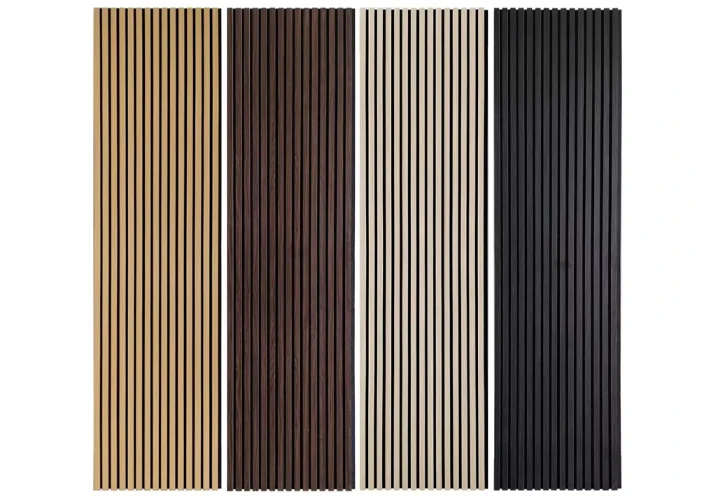
Teak-colored acoustic slat panels
Acoustic slat panels are among the most recognizable decorative acoustic products. Their regularly spaced vertical or horizontal slats create a structured architectural appearance while allowing sound to reach the acoustic backing.
They are frequently specified for hotel feature walls, corporate reception areas, meeting rooms, restaurants, and modern residential common spaces. Depending on the construction, they may be installed on walls or ceilings.
Teak-look decorative acoustic boards
These panels use a more continuous decorative surface, sometimes incorporating grooves, perforations, or a specially designed acoustic structure. They suit projects that require a relatively uniform wood appearance across a large wall.
Fabric-backed acoustic panels in teak-inspired interiors
In some projects, designers combine wood-look panels with fabric-wrapped absorbers. This creates a balance between warm decorative finishes and soft acoustic surfaces, particularly in conference rooms, auditoriums, and hospitality interiors.
Custom acoustic wall systems
Large commercial developments may require acoustic panels in specific widths, lengths, colors, or installation configurations. Custom systems can help maintain a consistent design across reception areas, corridors, guest rooms, and shared spaces.
The most appropriate type depends on the intended application, the required acoustic performance, the wall or ceiling substrate, and the project's technical specifications.
Why Is Teak a Popular Color for Commercial Interiors?
Teak-inspired finishes offer a warm, natural appearance without requiring every surface to use solid teak timber. Their brown tones can coordinate with neutral walls, stone-look flooring, metal details, glass partitions, leather furniture, and other architectural finishes.
Compared with very dark wood colors, medium teak tones can maintain a sense of warmth without making an interior feel excessively heavy. Compared with pale wood finishes, they can provide more visual contrast and help define feature walls or reception areas.
For developers and contractors managing multiple locations, a consistent teak-colored finish can also support a recognizable interior design language across hotels, offices, restaurants, and commercial buildings.
It is important to distinguish appearance from material composition. A teak-colored acoustic panel does not necessarily contain teak wood. Buyers should confirm whether the product uses a printed decorative surface, engineered wood veneer, laminate, or another finish when specifying materials for a project.
Teak-Colored Acoustic Panels for Hotels and Hospitality Projects
Hotels are one of the most suitable applications for teak-colored acoustic panels because hospitality interiors must balance visual quality, guest comfort, durability, and practical maintenance.
From the entrance to the guest room, different hotel spaces have different acoustic and decorative requirements. A coordinated acoustic wall system can help establish a consistent interior identity while addressing sound reflections in selected areas.
Hotel Lobbies and Reception Areas
A hotel lobby is often the first interior space guests experience. Reception desks, waiting areas, luggage movement, conversations, elevators, and background music can all contribute to the overall sound environment.
Teak-colored acoustic panels can be installed behind the reception counter, along feature walls, or on selected ceiling sections to introduce a warm, sophisticated appearance.
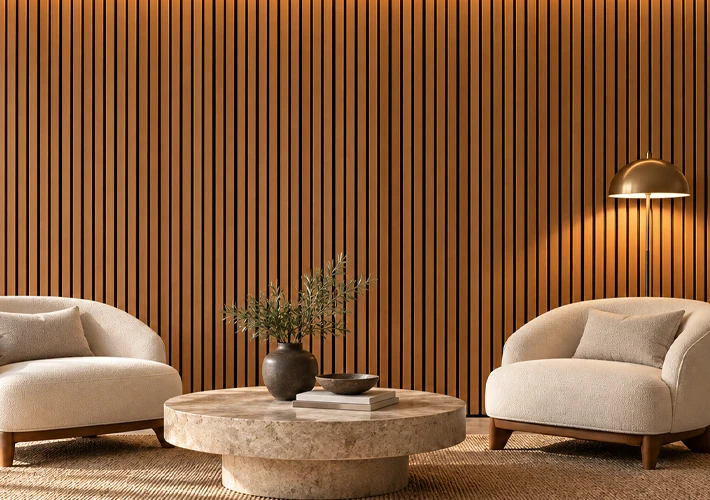
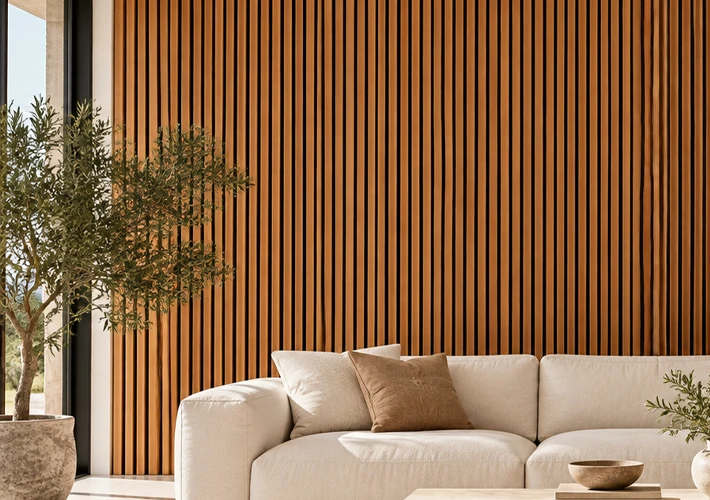
Vertical slatted panels work particularly well in contemporary hotel designs because they create a sense of height and rhythm. They can also be combined with stone-look surfaces, concealed lighting, metal trims, or branded signage.
For example, a hotel designer may specify a teak-colored slat wall behind the reception desk, a neutral stone-look floor, and indirect lighting to create a welcoming entrance. The acoustic backing can help reduce sound reflections when the complete assembly has suitable absorption characteristics.
For hotel developers, the main advantage is the opportunity to integrate decorative wall treatment and acoustic management into one coordinated design solution.
However, a large lobby with hard flooring, extensive glazing, and a high ceiling may still require additional acoustic treatment. Wall panels alone may not provide sufficient absorption for a highly reverberant space.
Hotel Guest Rooms and Headboard Walls
Guest rooms require a different approach from public areas. Privacy, relaxation, visual comfort, and easy maintenance are usually more important than creating a dramatic architectural statement.
Teak-colored acoustic panels can be used as headboard backgrounds, decorative wall sections, or accent surfaces behind seating areas. Their warm appearance complements upholstered beds, neutral curtains, soft lighting, and natural-tone furniture.
In a guest room, acoustic panels may help control sound reflections within the room. Nevertheless, decorative sound-absorbing panels should not be confused with soundproofing systems.
If a hotel operator wants to reduce noise transmitted between adjacent guest rooms, the project must also address partition construction, airtightness, doors, glazing, penetrations, and other sound-transmission paths.
Aesthetically coordinated wall panels can contribute to the overall room design, but they do not automatically deliver acoustic isolation between rooms.
For hotel procurement teams, useful specifications include the finished color, surface texture, panel dimensions, backing material, edge details, cleaning requirements, and compatibility with the intended wall substrate.
Hotel Corridors and Connecting Areas
Hotel corridors often contain repeated room doors, lighting fixtures, signage, and long uninterrupted wall surfaces. Teak-colored acoustic panels can break up these surfaces and establish a warmer, more residential atmosphere.
Vertical slats can visually emphasize corridor height, while horizontal arrangements can create a more expansive impression. Designers may install panels along selected wall sections rather than covering the entire corridor.
In high-traffic areas, the panel surface and mounting system should be selected for the expected level of contact and cleaning. Corners, edges, and lower wall sections may require additional protection.
Fire performance is particularly important in hotel corridors and other escape routes. The required classification depends on local building codes, the building type, the installation location, and the complete wall or ceiling assembly.
Project teams should obtain applicable fire-test documentation before approving the finish.
Hotel Restaurants, Lounges, and Bars
Restaurants and hotel lounges benefit from interiors that feel comfortable without appearing overly formal. Teak-colored acoustic panels can complement timber furniture, upholstered seating, pendant lights, and neutral decorative finishes.
They are suitable for feature walls behind banquettes, selected ceiling sections, private dining rooms, and lounge seating areas.
In restaurants, multiple conversations can create significant background noise, particularly when hard surfaces reflect sound throughout the room. Properly specified acoustic panels may help reduce reverberation and improve speech comfort.
The acoustic result depends on the panel's tested absorption performance, the total treated area, ceiling height, room volume, and other finishes. For a busy restaurant, designers should consider the entire room rather than assuming that a decorative slat wall will solve every noise problem.
Panels installed near food preparation areas must also be evaluated for cleaning, grease exposure, moisture, and hygiene requirements. Standard decorative acoustic panels are not automatically suitable for every kitchen or food-service environment.
Hotel Conference Rooms and Event Spaces
Hotels frequently include meeting rooms, training spaces, banquet facilities, and conference halls. These environments require good speech intelligibility, especially when presentations, discussions, and video conferencing take place.
Teak-colored acoustic panels can create a professional appearance on the walls behind presenters, along side walls, or on selected ceiling areas. They can also coordinate with conference tables, built-in cabinets, and other interior materials.
For smaller meeting rooms, a suitable acoustic wall treatment may help reduce excessive reverberation. Larger conference halls usually need a more comprehensive acoustic design that may include ceiling absorbers, wall panels, upholstered finishes, and other treatments.
Procurement teams should request documented acoustic test results rather than relying only on product appearance or general claims.
Teak-Colored Acoustic Panels for Offices and Corporate Interiors
Modern offices use a mixture of open workstations, meeting rooms, private offices, reception areas, collaboration zones, and employee lounges. Each space has a different sound environment, making acoustic material selection an important part of workplace design.
Teak-colored acoustic panels can help soften the appearance of commercial interiors that otherwise contain large amounts of glass, metal, white surfaces, and exposed building materials.
Corporate Reception and Client-Facing Areas
The reception area represents a company's brand and professional image. A teak-colored acoustic feature wall can introduce warmth and contrast while providing a suitable background for company signage.
For professional service firms, technology companies, property developers, and corporate headquarters, the combination of wood-look finishes and clean architectural lines can create an understated premium appearance.
Panels can be installed behind reception desks, along waiting-area walls, or around selected meeting-room entrances.
Where the panels have a suitable acoustic construction, they may also help manage sound reflections caused by hard flooring, glass partitions, and exposed ceilings.
For large corporate projects, designers should coordinate the panel finish with flooring, furniture, doors, lighting, and signage before finalizing the material schedule.
Open-Plan Offices and Collaboration Areas
Open-plan offices often experience a combination of conversations, keyboard noise, telephone calls, and movement. Acoustic design can help make these environments more comfortable, although wall absorption alone cannot eliminate all workplace noise.
Teak-colored acoustic panels may be installed on perimeter walls, collaboration-zone feature walls, or selected ceiling surfaces.
They can visually distinguish informal meeting areas from desk zones without introducing bulky partitions. A consistent wood-look finish can also help create a more welcoming environment within a large open office.
However, wall-mounted absorbers are not a substitute for appropriate workstation planning, acoustic ceiling systems, sound-masking strategies, or quiet-room provision where those measures are required.
The objective should be to improve the overall sound environment, not simply to cover as much wall area as possible.
Meeting Rooms and Boardrooms
Meeting rooms are among the strongest applications for decorative acoustic wall panels. Participants need to understand one another clearly, and remote attendees need to hear speech without excessive echo.
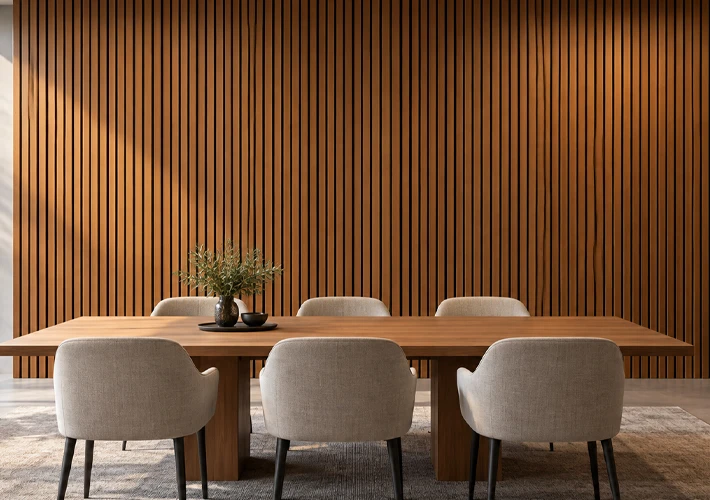
Teak-colored slat panels can provide an attractive background behind a display screen or presentation wall. Additional acoustic treatment may be placed on side walls or ceilings to address reflections from multiple directions.
For boardrooms, the finish can be coordinated with conference tables, cabinetry, glass partitions, and integrated audiovisual equipment.
Procurement specifications should include the panel construction, dimensions, mounting details, fire performance, and any acoustic performance requirements.
Where speech privacy is important, acoustic absorption must be combined with appropriate sound insulation, door seals, partition details, and mechanical-system considerations.
Executive Offices and Private Workspaces
Executive offices often use a restrained palette of wood, glass, metal, and neutral fabrics. Teak-colored acoustic panels fit naturally into this design approach.
They can be used behind desks, in private meeting areas, or as decorative surfaces around shelving and built-in storage. The result is a professional interior that feels warmer than a purely white or glass-based environment.
For smaller offices, selective panel placement is usually more practical than covering every wall. This can reduce material costs while preserving a clear design focal point.
Co-Working Spaces and Shared Business Centers
Co-working facilities need to accommodate different activities throughout the day, including focused work, video calls, informal meetings, and networking.
Teak-colored acoustic panels can help define meeting pods, phone-call areas, shared lounges, and reception zones. Their decorative finish supports a more refined environment, which can be valuable for operators targeting business travelers, startups, and professional tenants.
Because co-working spaces often change layouts, modular panels and accessible mounting systems may be preferable to complicated permanent installations.
Operators should also consider replacement availability and finish consistency when ordering materials for multiple locations or future expansions.
Teak-Colored Acoustic Panels for Restaurants, Cafes, Retail, and Entertainment Venues
Beyond hotels and offices, teak-colored acoustic panels are suitable for a variety of commercial interiors where designers want to combine natural-looking finishes with improved sound absorption.
Restaurants and Cafes
Restaurants and cafes frequently contain hard floors, glass windows, stone counters, and compact furniture arrangements. These surfaces can contribute to reflected sound, particularly during busy service periods.
Teak-colored acoustic panels can be installed behind seating areas, on selected feature walls, or as part of a coordinated ceiling design.
In a contemporary cafe, a teak-look slat wall can complement concrete-look flooring, black metal furniture, pendant lights, and indoor plants. In a restaurant, the same finish can be paired with upholstered banquettes and warm lighting to create a more intimate atmosphere.
The choice between wall-mounted and ceiling-mounted panels should be based on the layout, existing services, and acoustic objectives.
Food-service projects should also evaluate grease, humidity, cleaning chemicals, and the accessibility of the installed surfaces. Panels that are appropriate for a dining room may not be suitable directly beside a commercial cooking line.
Retail Stores and Showrooms
Retail environments rely on both visual presentation and a comfortable customer experience. Teak-colored acoustic panels can be used behind product displays, at checkout counters, along fitting-room corridors, and in customer consultation areas.
For furniture showrooms, flooring stores, building-material exhibitions, and interior design studios, the warm wood appearance can complement the products on display.
A showroom selling architectural finishes may use teak-colored acoustic panels alongside SPC flooring, decorative wall boards, cabinetry, or other coordinated materials to demonstrate a complete interior solution.
For retailers, consistency across multiple branches is important. Buyers should confirm color samples, batch variation, panel dimensions, packaging protection, and replacement availability before committing to a large order.
Shopping Centers and Commercial Common Areas
Shopping centers include entrances, corridors, waiting zones, food courts, customer service counters, and other shared spaces. Selected acoustic treatments may help manage reverberation in these environments.
Teak-colored panels can be used as feature surfaces around seating areas, information desks, tenant entrances, or indoor lounge zones.
Large public spaces typically require a broader acoustic strategy because of their volume, occupancy, and combination of hard surfaces. Decorative panels should be integrated into the overall design rather than treated as a complete solution by themselves.
Fire-safety compliance, durability, accessibility, and maintenance access are important considerations in public buildings.
Cinemas, Entertainment Venues, and Recreation Facilities
Entertainment venues have different acoustic requirements depending on their purpose. A cinema may need carefully controlled reflections and sound isolation, while a recreation lounge may focus on speech comfort and background noise.
Teak-colored acoustic panels can contribute to the decorative design of waiting areas, private entertainment rooms, lounge spaces, and selected interior walls.
For cinemas, performance venues, recording facilities, or rooms with demanding sound-control targets, a qualified acoustic consultant should determine the required assembly. Decorative wood-look panels alone should not be assumed to provide the isolation or frequency response needed for specialist applications.
Teak-Colored Acoustic Panels for Education, Healthcare, and Residential Developments
Institutional and residential projects can also benefit from teak-colored acoustic finishes, provided the selected product meets the relevant functional and regulatory requirements.
Schools, Universities, and Training Centers
Classrooms, libraries, lecture rooms, staff offices, and student collaboration areas all benefit from an appropriate acoustic environment.
Excessive reverberation can make speech more difficult to understand, particularly in rooms used for teaching or group discussion. Properly selected acoustic panels can help reduce reflected sound when installed in sufficient quantities and in suitable locations.
Teak-colored acoustic panels may be used in reception areas, library feature walls, meeting rooms, faculty offices, and selected classroom interiors.
For educational buildings, procurement teams should prioritize fire performance, impact resistance, cleanability, and compatibility with the institution's maintenance procedures.
Panels installed at student level may need more durable surfaces or additional protection against accidental impacts.
Healthcare Facilities and Medical Offices
Healthcare interiors need to support patient comfort, clear communication, and practical cleaning. Teak-colored acoustic panels may be considered for administrative offices, waiting areas, consultation rooms, staff lounges, and selected reception areas.
The warm wood appearance can make clinical or administrative environments feel less institutional.
However, healthcare projects often impose stricter requirements for hygiene, surface cleanability, chemical resistance, fire performance, and infection-control procedures. Not every felt-backed or porous acoustic product is appropriate for these applications.
Before specification, buyers should confirm whether the panel system is suitable for the intended healthcare zone and whether its surface can withstand the required cleaning protocol.
For spaces where frequent disinfection is necessary, a more easily cleaned acoustic solution may be preferable.
Apartments and Multifamily Residential Common Areas
In residential developments, teak-colored acoustic panels are often more useful in shared spaces than as a universal treatment for every apartment.
Potential applications include entrance lobbies, elevator waiting areas, shared lounges, property management offices, co-working rooms, and residents' meeting spaces.
Developers may use the same finish across multiple buildings to establish a consistent visual identity. Modular panel sizes and coordinated trim systems can simplify installation and future replacement.
For apartment interiors, panels can also be used behind televisions or in home office areas. However, if the objective is to prevent noise from neighboring apartments, buyers must distinguish between sound absorption within a room and sound insulation between rooms.
A decorative absorber can reduce some reflections but does not replace properly designed walls, floors, ceilings, and acoustic seals.
Libraries and Reading Areas
Libraries and study spaces require an environment that supports concentration and quiet conversation. Teak-colored acoustic panels can complement bookshelves, study desks, and other natural-tone finishes.
Wall-mounted panels may help manage reflections in reading rooms, collaborative study areas, and small discussion rooms.
In libraries, the selected panel surface should be durable and maintainable. Designers should also coordinate panel locations with shelving, lighting, fire equipment, signage, and other building services.
Religious and Community Buildings
Community centers, multipurpose halls, and some religious buildings use large interior volumes with reflective surfaces. Teak-colored acoustic panels may be incorporated into selected walls or ceilings to support the interior design and improve acoustic conditions.
The effectiveness of these panels depends on the room's geometry, volume, occupancy, and acoustic requirements. Larger assembly spaces may require specialist calculations and additional ceiling or wall treatment.
Fire-safety standards, installation height, access for maintenance, and structural fixing details should be reviewed before installation.
How to Choose the Right Teak-Colored Acoustic Panels for a Commercial Project
Selecting the right acoustic panel requires coordination between the decorative specification and the technical performance requirements. For importers, wholesalers, architects, and contractors, evaluating these factors before purchase can reduce project risks and avoid expensive substitutions.
Confirm the Acoustic Performance
The term "acoustic panel" covers products with different sound-management capabilities. Buyers should not assume that two panels with similar appearances will deliver the same results.
Important questions include:
What is the tested sound absorption performance of the complete panel assembly?
Is an NRC rating available, or is another relevant acoustic test report provided?
Under which test standard and mounting conditions was the result measured?
Does the project require sound absorption, sound insulation, or both?
Is additional ceiling or wall treatment necessary to achieve the target?
The Noise Reduction Coefficient (NRC) is a commonly used single-number indicator of sound absorption in certain frequency bands. It can help compare suitable products, but it does not describe every aspect of acoustic performance.
For demanding projects, buyers should review the full test report and the relevant frequency-dependent data rather than relying on an isolated marketing figure.
Select the Appropriate Material Construction
The construction of a teak-colored acoustic panel affects its appearance, durability, installation, and acoustic behavior.
A slatted system may combine decorative slats with a felt backing. Other products use perforated boards, engineered wood substrates, fabric coverings, or specially designed absorbent cores.
Buyers should confirm the exact material composition, including:
Decorative surface and finish type.
Core or substrate material.
Acoustic backing and thickness.
Panel thickness and overall dimensions.
Weight per panel or per square meter.
Edge treatment and joint details.
Recommended wall or ceiling installation method.
The most suitable construction depends on the intended space. For example, a decorative slat panel may suit a hotel lobby, while a washable and more tightly sealed surface may be more appropriate in a healthcare administrative area.
Check Fire Performance and Local Compliance
Fire performance is a critical consideration for commercial wall and ceiling finishes.
Requirements vary by country, building classification, installation location, and local code. Hotel corridors, public assembly areas, escape routes, and certain institutional spaces may be subject to specific restrictions.
Ask the manufacturer for applicable test reports and product documentation. Confirm that the documentation matches the actual product construction, including its backing, adhesive, substrate, and installation method where relevant.
A report for one panel configuration should not automatically be assumed to cover every variation of the same product family.
Evaluate Color Consistency and Surface Quality
Teak is a broad color category rather than a single standardized shade. Different manufacturers may offer light teak, golden teak, medium brown teak, or darker teak-inspired finishes.
The same color name can look different under daylight, warm LED lighting, and cool office lighting. Surface texture, grain direction, gloss level, and panel dimensions also affect the overall appearance.
For large commercial projects, request physical samples before approving the final finish.
Where multiple production batches will be used, discuss color tolerance, batch management, and the possibility of ordering the complete project quantity together. Confirm whether replacement panels will be available if future maintenance is required.
Match the Installation System to the Building
Installation requirements should be reviewed before the panels arrive on site.
Questions for the project team include:
Is the wall substrate flat, stable, and suitable for the proposed fixings?
Are mechanical fasteners, adhesive, battens, or a combination required?
Does the installation need a service cavity or additional acoustic backing?
How will corners, external edges, sockets, switches, and doors be finished?
Are ceiling installations subject to additional structural or suspension requirements?
How will the system accommodate maintenance access and future replacement?
Incorrect installation can compromise the finish, create uneven joints, or reduce the expected acoustic performance. Contractors should follow the manufacturer's instructions and obtain technical clarification when the proposed substrate differs from the tested installation.
Consider Cleaning, Moisture, and Durability
The operating environment determines how well a decorative acoustic panel will perform over time.
Hotel corridors and office reception areas may require frequent dust removal and occasional spot cleaning. Restaurants may expose panels to grease and odors. Healthcare spaces may require approved disinfectants. Humid climates can create additional risks for certain substrates and backing materials.
Buyers should confirm the permitted cleaning methods, moisture limitations, and environmental conditions for the specific product.
Teak-colored decorative panels should not automatically be treated as waterproof simply because their surface resembles a wood-look laminate. Moisture resistance depends on the complete product construction, joints, edges, and installation details.
For wet areas, direct water exposure, or spaces with substantial humidity, choose a system specifically documented for those conditions.
Compare Total Project Cost, Not Only Unit Price
A low panel price does not always translate into the lowest installed cost.
Commercial procurement teams should evaluate the full project cost, including:
Panel material price.
Acoustic backing and supplementary components.
Installation accessories and trim.
Freight, insurance, and import duties.
Installation labor.
Cutting waste and spare materials.
Maintenance and future replacement.
Compliance testing or documentation where required.
For large orders, compare quotations using the same specifications, dimensions, finish, packaging requirements, and delivery terms.
This makes it easier to distinguish genuine cost advantages from quotations that exclude important components.
Why Source Teak-Colored Acoustic Panels from AesthEdge in China?
For international distributors, importers, architects, and commercial contractors, choosing a reliable manufacturing partner is an important part of successful project delivery.
A suitable supplier should do more than offer an attractive catalog. The supplier should be able to clarify product construction, provide relevant technical documents, coordinate samples, confirm production specifications, and communicate clearly about packaging and shipment.
إيسث إيدج is a Chinese building materials supplier focused on decorative interior and architectural surface solutions. Its product range includes acoustic panels and other decorative wall materials designed for commercial and interior projects.
For buyers evaluating teak-colored acoustic panels, working directly with a China-based supplier can offer several practical advantages when the product specifications and supply arrangements match the project requirements.
Product Coordination for Commercial Interiors
Commercial developments frequently use multiple materials in the same space. A hotel may require acoustic panels alongside SPC flooring, decorative wall boards, PVC marble-look panels, cabinetry, doors, and other interior finishes.
Coordinating these products through a supplier with a broader decorative materials range can simplify specification discussions and help project teams align colors, dimensions, and finish expectations.
AesthEdge can support buyers seeking coordinated wall material solutions for hospitality, commercial, and other interior applications, subject to product availability and project specifications.
For example, a hotel procurement team may evaluate teak-colored acoustic panels for a reception feature wall and compare complementary decorative materials for guest rooms and corridors. The final combination should be approved using physical samples and project-specific technical documentation.
Customization for Different Markets and Project Requirements
International buyers often require different panel dimensions, colors, surface textures, or packaging arrangements to meet their local market needs.
Before requesting a customized order, distributors and contractors should prepare a clear specification that identifies the intended application, preferred teak shade, panel size, thickness, construction, quantity, and required documentation.
Customization possibilities depend on the specific product and manufacturing arrangements. Buyers should confirm minimum order quantities, available finish options, tooling or setup costs, sample lead times, and production schedules directly with the supplier.
A clear specification helps prevent misunderstandings between the design team, purchasing department, manufacturer, and installer.
Samples and Technical Documentation
For commercial wall panels, approving a sample before mass production is an important quality-control step.
AesthEdge buyers should request samples to assess the actual teak color, surface texture, edge finish, and compatibility with surrounding materials.
Where acoustic or fire performance is part of the project specification, buyers should also request the applicable technical documents and confirm that the tested product corresponds to the proposed order.
Useful documentation may include product data sheets, installation instructions, maintenance guidance, acoustic test reports, and fire-performance reports where available and applicable.
These documents support a more reliable procurement process than relying on product photographs alone.
Supply Planning for Importers and Project Contractors
International projects depend on consistent communication about order quantities, production schedules, packaging, shipping arrangements, and delivery requirements.
Before confirming an order, buyers should establish the agreed product specifications, inspection arrangements, carton or pallet details, shipment terms, and expected production timeline.
For repeat projects, maintaining an approved sample and a written specification can help reduce finish inconsistencies between orders.
Distributors should also consider the practical requirements of their target market, including local compliance expectations, warehouse handling, product labeling, and replacement stock.
AesthEdge works with international buyers seeking Chinese-source decorative building materials. Project-specific availability, pricing, and delivery arrangements should be confirmed directly before a purchase commitment is made.
Conclusion: Where Can Teak-Colored Acoustic Panels Be Used?
Teak-colored acoustic panels are versatile decorative materials for commercial and institutional interiors that require a warm wood appearance alongside sound absorption.
Their most suitable applications include hotel lobbies, reception counters, guest-room feature walls, corridors, restaurants, meeting rooms, corporate offices, retail showrooms, education facilities, residential common areas, and selected healthcare or community spaces.
The correct product depends on the acoustic objective, panel construction, fire-safety requirements, cleaning conditions, installation method, and project budget. Buyers should also distinguish sound absorption from sound insulation and request relevant test documentation when performance requirements are important.
For importers, distributors, architects, and commercial contractors sourcing decorative wall materials from China, AesthEdge offers a point of contact for exploring acoustic panels and coordinated interior finish solutions.
If you are planning a hotel, office, restaurant, showroom, or other commercial interior project, contact AesthEdge to discuss teak-colored acoustic panel options, sample availability, product specifications, customization possibilities, and project supply requirements.
Frequently Asked Questions About Teak-Colored Acoustic Panels
1. Are teak-colored acoustic panels suitable for hotels?
Yes. They can be used in hotel lobbies, reception areas, guest-room feature walls, corridors, restaurants, lounges, and meeting rooms. The selected product must meet the project's acoustic, fire-safety, durability, and maintenance requirements.
2. Do teak-colored acoustic panels reduce noise?
Panels with suitable sound-absorbing construction can reduce reflected sound and help control reverberation. Their effectiveness depends on the product's tested performance, installation method, treated surface area, and room characteristics.
They do not automatically prevent sound from passing through walls or between rooms.
3. Can teak-colored acoustic panels be installed on ceilings?
Some systems are suitable for ceiling installation, but not every wall panel is designed for overhead use. Confirm the manufacturer's installation instructions, fixing method, panel weight, structural requirements, and applicable fire performance before specifying ceiling-mounted products.
4. Are teak-colored acoustic panels waterproof?
Not necessarily. A wood-look decorative surface does not guarantee that the panel, backing, edges, and joints are waterproof. Buyers should confirm the product's moisture resistance and suitability for the intended environment.
5. What is the difference between teak-colored acoustic panels and solid teak wall panels?
Teak-colored acoustic panels are defined by their appearance and acoustic-oriented construction. They may use engineered substrates, decorative laminates, printed finishes, or other wood-look surfaces.
Solid teak wall panels use actual teak timber. Their appearance, material cost, maintenance needs, and acoustic characteristics may differ considerably.
6. How do buyers evaluate acoustic panel performance?
Request the manufacturer's technical data and applicable laboratory test reports. Depending on the project, useful information may include NRC or frequency-specific absorption data, panel thickness, backing construction, mounting conditions, and fire-performance classification.
The correct evaluation method depends on the project's acoustic requirements and local regulations.
7. Can AesthEdge supply teak-colored acoustic panels for wholesale or commercial projects?
AesthEdge is a China-based decorative building materials supplier serving international buyers. Contact the company to confirm available acoustic panel designs, color options, sample arrangements, minimum order quantities, customization possibilities, and delivery schedules for your project.
8. What information should be included in an acoustic panel inquiry?
For a more accurate quotation, provide the intended application, estimated quantity, panel dimensions, preferred teak color, installation location, destination country, required technical standards, and target delivery schedule. Drawings, photographs, or a material schedule can help the supplier understand the project requirements.



 Arabic
 English
 French
 Russian
 Spanish
 Portuguese
 Japanese