Choosing the right decorative surface is an important decision for importers, wholesalers, furniture manufacturers, interior contractors, and commercial project buyers. Among the decorative materials gaining attention in modern interior design, bamboo charcoal wood veneer stands out for its versatile appearance, convenient installation potential, and wide range of surface finishes. Two popular options are matte bamboo charcoal wood veneer and skin-feel bamboo charcoal wood veneer.
Although both finishes can be used to create contemporary interior spaces, they offer different visual effects, tactile experiences, and commercial positioning. Matte finishes are generally preferred for understated elegance, reduced glare, and a clean architectural appearance. Skin-feel finishes, meanwhile, are designed to provide a softer, smoother, more tactile surface that can enhance the perceived quality of furniture and decorative wall applications.
For B2B buyers, the difference goes beyond appearance. Selecting the right finish affects product positioning, customer expectations, sample approval, maintenance requirements, project coordination, and overall purchasing decisions. Importers also need to consider substrate construction, surface consistency, dimensional specifications, packaging, quality control, and the supplier's ability to support repeat orders.
As a China-based decorative materials supplier, AesthEdge provides solutions for buyers seeking modern wall finishes and interior decorative materials for residential, hospitality, office, retail, and other commercial applications. Understanding the differences between matte and skin-feel bamboo charcoal wood veneer can help buyers select products that match their target market and project requirements.
This guide explains the main differences between the two finishes, their advantages and limitations, suitable applications, purchasing considerations, and the questions buyers should ask before placing a bulk order.
What Is Bamboo Charcoal Wood Veneer?
Bamboo charcoal wood veneer is a decorative interior finishing material designed to reproduce the appearance of wood, stone, solid colors, or other contemporary surface patterns. Depending on the product series, its construction may incorporate a decorative surface layer, a bamboo-charcoal-related composite substrate, and additional functional or protective layers.
The term "bamboo charcoal" is commonly used in the decorative materials market to describe a category of composite interior panels. However, the exact formulation, substrate composition, manufacturing process, and surface treatment can vary between manufacturers. Buyers should therefore verify the technical specifications of the particular product rather than assuming that all bamboo charcoal wood veneer panels have the same composition.
Unlike traditional solid wood veneer, which uses a thin layer of natural wood, decorative bamboo charcoal wood veneer products may use printed or otherwise finished surfaces to achieve consistent colors, wood grains, and modern decorative effects. This makes them suitable for projects that require coordinated finishes across multiple rooms, furniture components, or wall areas.
Common applications
Bamboo charcoal wood veneer is commonly considered for:
Interior feature walls in hotels, apartments, and residential developments.
Living room background walls and bedroom headboards.
Office reception areas, meeting rooms, and executive offices.
Retail stores, showrooms, and commercial display spaces.
Decorative surfaces for cabinets, wardrobes, and selected furniture components.
Hotel corridors, guestroom interiors, and selected public areas.
The suitability of a particular panel depends on its construction, thickness, installation method, fire performance, environmental documentation, and the conditions of the intended application.
For B2B buyers, one important advantage of working with a decorative materials supplier is the possibility of coordinating multiple finishes within a broader interior design scheme. A single project may require matte panels for large wall surfaces and skin-feel panels for furniture accents or selected feature areas.
Why surface finish matters
The surface finish is one of the first characteristics that customers notice when evaluating a decorative panel. It affects how light interacts with the material, how the surface feels when touched, and how the product is perceived in a finished interior.
Two panels with similar colors and patterns may produce very different impressions when one has a matte surface and the other has a skin-feel finish. The former may look understated and architectural, while the latter may emphasize softness and a refined tactile experience.
For distributors, this distinction creates an opportunity to offer different product grades, design collections, or price-positioning options without necessarily changing the overall interior design concept.
For project contractors, finish selection should be confirmed early in the specification process. It is easier to maintain a consistent appearance when the surface finish, color, panel dimensions, and installation details are approved before materials are ordered.
What Is Matte Bamboo Charcoal Wood Veneer?
Matte bamboo charcoal wood veneer features a low-gloss or non-glossy decorative surface. Rather than reflecting strong highlights, it generally presents a more restrained appearance that allows the underlying color, texture, and decorative pattern to remain visually prominent.
Matte finishes are widely used in contemporary interior design because they complement minimalist, modern, Scandinavian-inspired, industrial, and understated luxury styles. Depending on the particular surface treatment, a matte panel may appear smooth, subtly textured, or slightly grainy.
The exact appearance depends on the manufacturer's finish formulation and product design. A matte surface should not automatically be assumed to be completely reflection-free, fingerprint-proof, scratch-proof, or easy to clean under every condition.
Key characteristics of matte finishes
1. Low-gloss appearance
The most recognizable characteristic of matte bamboo charcoal wood veneer is its restrained reflection. It can help reduce distracting highlights from ceiling lights, windows, and decorative lighting fixtures.
This characteristic is useful for large wall surfaces where excessive shine could compete with furniture, artwork, signage, or other interior elements.
2. Understated and versatile design
Matte finishes work well with neutral colors, warm wood tones, concrete-inspired surfaces, metal accents, and many contemporary furniture styles.
For example, a matte oak-effect panel may complement a minimalist hotel bedroom, while a matte dark gray surface may suit a corporate reception area or a modern retail interior.
3. Visual consistency across large surfaces
When the same approved finish is used across a wall or multiple rooms, matte panels can create a visually coordinated background. Their relatively restrained reflection can also make differences in lighting less visually distracting than some high-gloss surfaces.
However, consistency still depends on production quality, decorative film matching, batch control, and correct installation. Matte finishes do not eliminate differences caused by color variation or directional patterns.
4. Broad commercial positioning
Matte decorative panels can serve a wide range of customer groups, from budget-conscious interior contractors to wholesalers supplying mid-range commercial projects.
Their appeal comes from design flexibility rather than a single specialized visual effect. This can make matte finishes a practical option for distributors who want a versatile product range.
Advantages of matte bamboo charcoal wood veneer
Matte finishes offer several potential advantages for commercial buyers.
First, they provide a timeless appearance that is less dependent on short-term decorative trends. Importers can include neutral matte colors in their core inventory and use them across multiple customer segments.
Second, low-gloss surfaces may make small smudges and light surface irregularities less visually prominent than highly reflective surfaces, although actual fingerprint visibility depends on color, texture, coating, and lighting.
Third, matte panels can be coordinated with many other decorative materials. They may be combined with acoustic wall panels, decorative metal trims, flooring, cabinetry, and other interior finishes.
Fourth, their understated appearance makes them suitable for projects where the wall finish should complement the overall design instead of becoming the dominant visual feature.
Potential limitations
Matte bamboo charcoal wood veneer is not automatically superior for every project.
Some matte surfaces can be more difficult to clean if they have a pronounced texture or a coating that retains oily marks. Dark matte colors may also show dust or light-colored scratches under certain lighting conditions.
In addition, matte panels may not provide the soft tactile sensation that buyers associate with skin-feel finishes. For furniture applications where customers frequently touch the surface, the difference can be noticeable.
Buyers should therefore evaluate both the appearance and the actual surface performance. A sample should be checked under the lighting conditions expected in the final project, with attention to color, reflection, texture, and cleaning requirements.
What Is Skin-Feel Bamboo Charcoal Wood Veneer?
Skin-feel bamboo charcoal wood veneer is designed to provide a soft, smooth, and pleasant tactile sensation. Depending on the specific product, this effect may be achieved through a specialized surface coating, a particular decorative layer, or a combination of surface treatments and substrate construction.
The expression "skin-feel" describes the intended touch experience rather than a universal technical standard. Different manufacturers may use the term for products with different coating technologies, textures, gloss levels, and performance characteristics.
For this reason, buyers should not assume that every skin-feel panel has the same softness, fingerprint resistance, scratch resistance, or durability. A supplier's physical samples and technical documentation are essential when comparing products.
Key characteristics of skin-feel finishes
1. A smooth and soft tactile experience
The defining characteristic is how the surface feels when touched. A suitable skin-feel finish may provide a smooth, soft-touch sensation that creates a more refined impression than a conventional decorative surface.
This quality can be particularly valuable for applications where users interact with the material at close range, such as cabinet fronts, wardrobe surfaces, furniture accents, and selected feature walls.
2. A premium decorative impression
Skin-feel surfaces are often positioned for interiors that emphasize comfort, contemporary aesthetics, and perceived material quality.
When combined with appropriate colors and patterns, they can help create a sophisticated appearance in hotel guestrooms, luxury residential interiors, executive offices, and boutique retail environments.
However, a premium tactile finish does not necessarily mean the product is more durable or suitable for every commercial application. Performance must be verified separately.
3. Compatibility with modern color palettes
Skin-feel finishes are frequently considered for neutral and contemporary colors, including beige, warm gray, cream, charcoal, and muted wood tones.
The final appearance depends on the decorative design and the particular coating. Some skin-feel products are nearly matte, while others have a subtle sheen. Consequently, skin-feel and matte are not always mutually exclusive categories: one describes a tactile effect, while the other primarily describes optical appearance.
4. Greater emphasis on close-contact applications
In some interiors, the surface is not simply a background. It becomes part of the user's physical experience.
A wardrobe door, cabinet panel, bedside feature, or furniture accent may be touched repeatedly throughout the day. A skin-feel finish can help manufacturers and designers differentiate these elements from products using standard decorative surfaces.
Advantages of skin-feel bamboo charcoal wood veneer
One major advantage is product differentiation. For importers and distributors, a tactile finish provides a clear selling point beyond color and pattern.
Instead of offering only conventional wood-effect panels, a distributor can introduce a skin-feel collection designed for customers seeking a more refined surface experience.
A second advantage is its suitability for design-led projects. Interior designers can use skin-feel finishes to introduce contrast between tactile furniture surfaces and more conventional wall panels.
A third advantage is its potential to strengthen perceived product value. In suitable markets, customers may be willing to consider a higher-priced decorative option when the finish offers a noticeable difference in touch and appearance. Actual pricing depends on the coating system, product specifications, production volume, and supplier.
Finally, skin-feel finishes can support product segmentation. Manufacturers and wholesalers may develop separate standard and premium collections to serve different project budgets.
Potential limitations
Skin-feel bamboo charcoal wood veneer should be evaluated carefully before being specified for high-traffic commercial environments.
Some soft-touch coatings may be more sensitive to abrasion, oily fingerprints, aggressive cleaners, or prolonged friction than other surface treatments. Other products may be engineered to provide improved resistance, but these claims need to be supported by product-specific test results.
A smooth surface can also show certain marks under directional lighting, depending on its color and coating characteristics.
For this reason, buyers should request information about cleaning procedures, surface durability, chemical resistance, and any available scratch or abrasion testing. If the material will be used on furniture or cabinet fronts, sample testing under realistic handling conditions is particularly useful.
Skin-feel panels should also be evaluated for consistency between samples and bulk production. A subtle difference in tactile sensation or sheen can become noticeable when several panels are installed side by side.
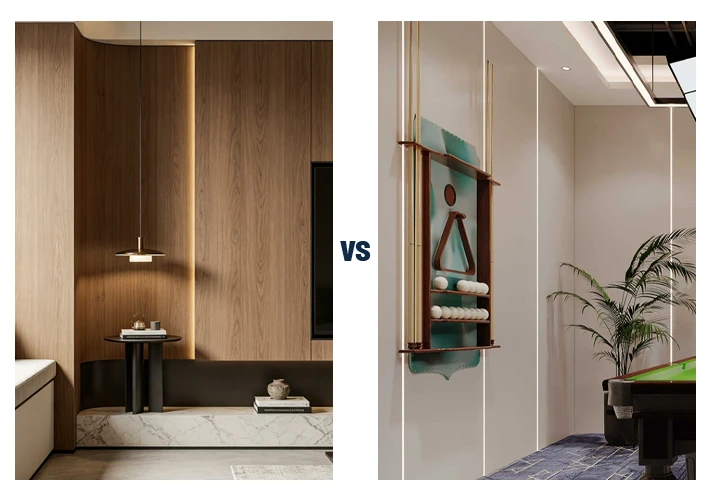
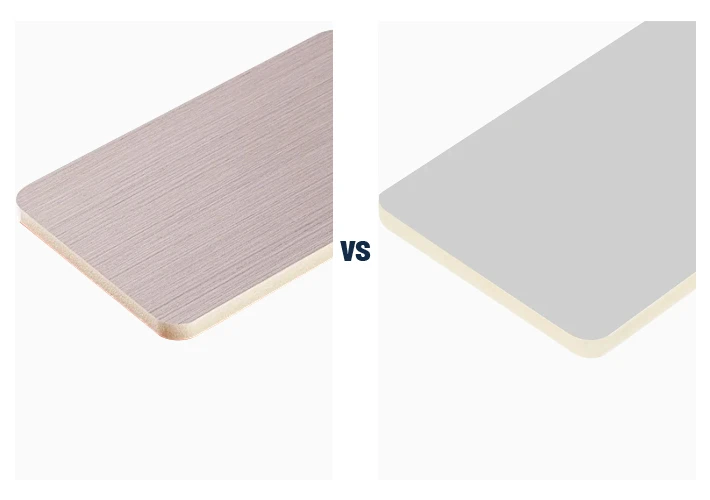
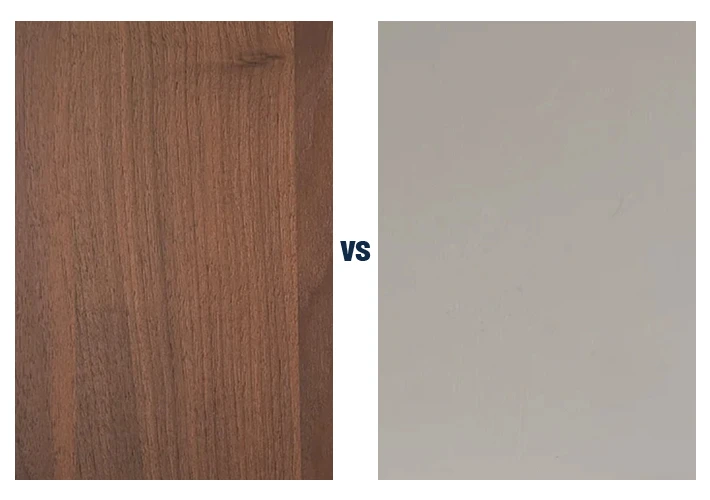
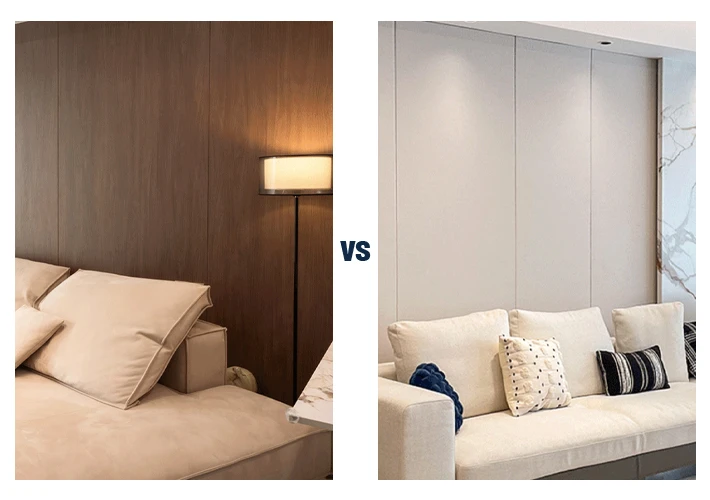
Matte vs Skin-Feel Bamboo Charcoal Wood Veneer: Key Differences
Although matte and skin-feel bamboo charcoal wood veneer may share similar decorative patterns and substrate options, their main differences concern surface appearance, touch, market positioning, and the priorities of the intended application.
The following comparison provides a practical starting point for procurement teams.
Comparison factor
Matte bamboo charcoal wood veneer
Skin-feel bamboo charcoal wood veneer
Primary feature
Low-gloss visual appearance
Soft, smooth tactile experience
Surface reflection
Generally low
Varies by product; often low to subtle sheen
Touch sensation
Depends on the surface texture and coating
Specifically designed to feel soft or smooth
Design style
Minimalist, modern, understated
Refined, contemporary, tactile
Typical positioning
Versatile standard or premium decorative range
Often positioned as a premium decorative option
Common applications
Large wall areas, offices, retail, hotels, residential interiors
Matte finishes are selected primarily for their optical characteristics. Their low-gloss appearance can make a wall look calm and visually balanced, especially in interiors with multiple light sources.
Skin-feel finishes are selected primarily for their tactile qualities, although their visual appearance is also important. Some skin-feel products have a matte appearance, while others feature a slight sheen.
This means buyers should avoid comparing products based only on their names. A matte panel and a skin-feel panel may look similar in photographs but feel very different when touched.
For projects where reflection is the main concern, buyers should focus on gloss level and surface appearance. For projects where the tactile experience matters more, the softness and smoothness of the skin-feel finish should receive greater attention.
Difference 2: Tactile experience
The tactile difference is often the most important distinction.
A conventional matte surface may feel smooth, textured, or slightly rough depending on its construction. A skin-feel surface is specifically intended to create a soft-touch sensation.
This difference can influence how customers perceive a finished cabinet, wardrobe, headboard, or decorative wall.
For furniture manufacturers, tactile quality may be particularly relevant because customers often interact directly with doors, drawer fronts, and other surfaces. For large decorative wall installations, appearance and ease of maintenance may carry greater weight than touch.
Difference 3: Commercial positioning and price
Matte bamboo charcoal wood veneer is generally a versatile choice for buyers who need a broad range of colors and finishes for different project types.
Skin-feel products can provide a stronger differentiation point for distributors targeting customers who value surface texture and a more premium decorative experience.
However, skin-feel finishes are not automatically more expensive in every market. Pricing depends on the manufacturing process, raw materials, coating technology, panel dimensions, order volume, customization requirements, and packaging.
When comparing supplier quotations, buyers should ensure that both products have comparable dimensions, substrate specifications, surface performance, and included accessories. Comparing only the price per panel can lead to misleading conclusions.
A more useful comparison considers the total delivered cost, expected installation requirements, product consistency, and suitability for the intended market.
Difference 4: Maintenance and durability
Neither finish should be described as universally easier to maintain or more durable without product-specific evidence.
A matte panel with a suitable protective coating may be easy to clean, while another matte surface with a pronounced texture may retain dust or marks.
Similarly, a skin-feel panel may offer good resistance to everyday handling if it has been properly engineered, but some soft-touch coatings may be sensitive to certain chemicals or abrasive cleaning methods.
Buyers should request written maintenance instructions and confirm which cleaning products are compatible with the surface.
For commercial projects, it is useful to test samples using the expected cleaning routine before approving the product for bulk installation.
Difference 5: Consistency during bulk production
For importers and wholesalers, consistency matters as much as the initial appearance.
A sample may look excellent, but a large order can become difficult to manage if the production batch differs in color, sheen, texture, or tactile sensation.
Matte products should be evaluated for consistent gloss level, color, pattern direction, and surface uniformity. Skin-feel products should additionally be checked for consistent touch characteristics and coating performance.
A practical procurement process includes a confirmed reference sample, an agreed specification sheet, and a defined inspection procedure. For repeat orders, buyers should retain approved samples and record product codes, color references, dimensions, and other relevant details.
Which Finish Is Better for Different Commercial Applications?
The right finish depends on how the material will be used, how often it will be touched, the desired interior style, and the maintenance expectations of the project.
For B2B buyers, it is often more useful to select finishes by application than to declare one finish universally superior.
Hotels and hospitality projects
Hotels require a balance between appearance, maintenance, consistency, and purchasing efficiency.
Matte bamboo charcoal wood veneer is suitable for many hotel feature walls, guestroom backgrounds, corridor accents, and reception areas where a restrained, contemporary appearance is preferred.
For example, a hotel operator may choose matte wood-effect panels for a large wall behind the bed, combining them with coordinated flooring, lighting, and furniture.
Skin-feel finishes may be appropriate for selected guestroom furniture, wardrobe fronts, decorative cabinet surfaces, or feature areas where a soft-touch impression contributes to the intended design.
However, hotel buyers should evaluate the expected frequency of cleaning, the likelihood of contact with luggage or furniture, and the project's fire and environmental requirements. Decorative appearance alone is not sufficient for material approval.
For hospitality procurement, a mixed-finish strategy can be effective: use matte panels for extensive wall coverage and skin-feel panels for selected high-visibility details.
Residential developments and apartments
Residential developers often prioritize design consistency, manageable costs, and broad market appeal.
Matte finishes can be suitable for living room feature walls, bedroom backgrounds, wardrobes, and general interior decorative applications. Neutral colors are particularly useful when the same material needs to coordinate with multiple furniture styles.
Skin-feel finishes can be considered for premium apartment collections, upgraded wardrobe systems, selected cabinet surfaces, or interiors positioned around comfort and contemporary design.
For developers purchasing for multiple units, the finish should be evaluated alongside the complete material schedule. A consistent color and panel specification helps reduce visual differences between units and simplifies replacement planning.
Offices and commercial interiors
Office interiors often use decorative surfaces to establish a professional atmosphere without creating excessive visual distraction.
Matte bamboo charcoal wood veneer can work well in reception areas, meeting rooms, executive offices, and feature walls. Its low-gloss appearance may be helpful in spaces with overhead lighting or substantial natural light.
Skin-feel panels may be used for selected furniture elements, reception counters, cabinet fronts, or executive interior accents.
For commercial offices, procurement teams should also consider cleaning frequency, furniture contact, fire-performance documentation, and local building regulations.
Retail stores and showrooms
Retail spaces frequently combine decorative materials to communicate a brand's identity.
Matte finishes can provide a neutral background for products, display lighting, and signage. They are particularly useful when the merchandise rather than the wall surface should attract the most attention.
Skin-feel panels may be more suitable for display elements where customers can touch the surface or where a refined material experience forms part of the brand presentation.
Showroom buyers can also use both finishes to create a clear product hierarchy, with matte collections serving as versatile options and skin-feel collections serving customers seeking more distinctive finishes.
Furniture and cabinetry manufacturing
Furniture manufacturers should consider the relationship between the decorative surface, substrate, edge treatment, and intended manufacturing process.
Matte panels may be appropriate for wardrobe surfaces, selected cabinet components, decorative furniture panels, and coordinated interior joinery.
Skin-feel products may be attractive for cabinet fronts, furniture accents, and other components where customers frequently interact with the surface.
Before mass production, manufacturers should confirm compatibility with cutting, trimming, edge finishing, adhesive systems, and any required machining operations. The appropriate process depends on the actual panel construction rather than the finish name alone.
A trial run is recommended when introducing a new finish into an existing production line. This helps identify potential issues with cutting quality, surface damage, edge appearance, or assembly.
Commercial application summary
Project type
Recommended starting point
Key consideration
Hotel feature walls
Matte
Uniform appearance and maintenance
Premium hotel furniture
Skin-feel
Touch quality and coating durability
Apartment developments
Matte or mixed finishes
Cost control and repeat-order consistency
Executive offices
Matte or selected skin-feel accents
Professional appearance and cleaning
Retail displays
Either, depending on design
Lighting, customer interaction, and branding
Wardrobes and cabinet fronts
Skin-feel or matte
Handling, edge finishing, and abrasion
Large wall installations
Often matte
Surface uniformity and visual coordination
These are general selection guidelines. Final suitability depends on the technical characteristics of the specific product and the project's requirements.
How to Choose the Right Product for Bulk Purchasing
For overseas buyers, choosing between matte and skin-feel bamboo charcoal wood veneer is only one part of the procurement process. The supplier must also deliver consistent quality, reliable specifications, suitable packaging, and clear communication.
The following factors can help importers, wholesalers, and project contractors reduce purchasing risks.
1. Confirm the product construction
Ask the manufacturer for the complete product specification, including the substrate composition, surface layer, thickness, dimensions, weight where applicable, and installation recommendations.
Do not assume that two panels described as bamboo charcoal wood veneer have identical construction. Product composition and performance can vary considerably.
If the material is intended for a specific project, confirm that the proposed construction meets the architect's or contractor's requirements before placing an order.
2. Request physical samples
Photographs are useful for initial screening, but they cannot fully communicate surface texture, tactile quality, or actual color.
For matte products, inspect the gloss level, decorative pattern, color uniformity, and reflection under different lighting conditions.
For skin-feel products, evaluate the softness, smoothness, surface consistency, and resistance to marks from normal handling.
Whenever possible, request samples from the actual product series being quoted. If several colors are under consideration, request representative samples of each color.
3. Compare specifications before comparing prices
A low quotation may reflect different dimensions, thicknesses, surface treatments, packaging arrangements, or included accessories.
Before comparing suppliers, create a specification sheet covering the following items:
Product name and finish type.
Panel dimensions and thickness.
Substrate and surface construction.
Color, texture, and decorative pattern.
Tolerances and acceptable appearance variation.
Available test reports and compliance documentation.
Packaging method and loading requirements.
Minimum order quantity and production lead time.
Warranty terms and after-sales procedures.
This approach helps purchasing teams compare quotations on a consistent basis.
4. Evaluate quality-control procedures
Ask the manufacturer how it controls surface quality, dimensions, color consistency, and packaging.
For matte panels, quality checks may include visible defects, gloss uniformity, pattern alignment, and dimensional accuracy.
For skin-feel panels, inspection may also focus on coating uniformity, tactile consistency, and the presence of marks or surface defects.
Buyers should establish clear acceptance criteria before production begins. For larger orders, an agreed inspection plan can reduce disagreements during shipment or installation.
5. Confirm customization capabilities
Different markets may prefer different colors, patterns, dimensions, and packaging formats.
A wholesaler serving residential renovation customers may need popular neutral colors in standard sizes, while a hotel contractor may require specific dimensions and a coordinated decorative scheme.
Ask whether the supplier can support the required color selection, panel dimensions, surface finish, product labeling, and packaging arrangements.
Customization should be confirmed in writing, including any tooling or development costs, minimum quantities, sample approval requirements, and potential effects on production time.
6. Calculate the total landed cost
The factory price is only one component of the final purchasing cost.
For international orders, buyers should consider product cost, packaging, inland transportation, freight, insurance where applicable, customs duties, import taxes, handling, and local delivery.
It is also useful to calculate the quantity required for the project, allowing for cutting waste, installation conditions, and a reasonable quantity of replacement material.
A slightly more expensive product may offer better overall value if it reduces installation complications or better matches the project's performance requirements. Conversely, a premium finish may not provide sufficient value for an application where its tactile qualities will rarely be noticed.
7. Confirm packaging and shipment arrangements
Decorative panels need packaging appropriate to their dimensions, surface sensitivity, and transport conditions.
Ask the supplier how panels are protected against scratches, edge damage, moisture exposure during transportation, and movement inside the shipping package.
For skin-feel surfaces, protection against rubbing and abrasion during handling can be particularly important. Matte panels also require suitable protection to prevent scratches, contamination, and visible surface damage.
For container shipments, confirm the packing list, package dimensions, gross and net weights, loading arrangement, and shipment documentation before dispatch.
8. Verify compliance for the destination market
Different countries and project types may impose different requirements on interior decorative materials.
Depending on the application, buyers may need documentation concerning formaldehyde emissions, volatile organic compounds, fire performance, or other environmental and building-code requirements.
Do not rely on broad claims such as "eco-friendly," "non-toxic," or "fireproof" without reviewing the applicable evidence. Request relevant test reports, identify the exact product covered by each report, and verify whether the documentation is accepted in the destination market.
For hotels, public buildings, and other regulated commercial projects, compliance should be checked before product approval rather than after the goods have been manufactured.
9. Consider long-term supply reliability
For distributors, a supplier's ability to maintain consistent specifications over multiple orders can be more important than the initial sample.
Ask about production capacity, typical lead times, raw material availability, quality-control procedures, and the process for handling defects or replacement requests.
If a product will be used in a multi-phase project, discuss how the supplier can manage repeat orders and whether the same decorative finish can be maintained over time.
A reliable supplier relationship helps importers maintain stock, respond to customer inquiries, and reduce the risk of inconsistent products entering the market.
Why Source Matte and Skin-Feel Bamboo Charcoal Wood Veneer from AesthEdge?
For importers, wholesalers, and commercial project buyers, selecting a decorative finish is only part of the decision. The supplier must also understand the requirements of international procurement, including product selection, specification confirmation, sample evaluation, and shipment coordination.
إيسث إيدج is a China-based decorative materials supplier serving buyers looking for coordinated interior finishing solutions. For customers evaluating matte and skin-feel bamboo charcoal wood veneer, a structured sourcing process can help connect the intended design with the required product specifications.
Product selection for different market segments
Not every customer requires the same finish. A distributor serving mainstream renovation projects may prioritize versatile matte surfaces, while a supplier to premium furniture manufacturers may place greater emphasis on skin-feel finishes.
AesthEdge can work with buyers to identify the relevant product options and clarify the differences between available finishes, subject to the specifications and customization capabilities of the selected product series.
For B2B buyers, this helps create a product portfolio that reflects local demand rather than relying on a single decorative finish.
Support for commercial and hospitality projects
Hotels, offices, retail stores, and residential developments often require multiple decorative materials to work together.
A coordinated sourcing approach can help purchasing teams consider wall finishes alongside other interior materials, including decorative wall panels, flooring, cabinetry, and complementary surfaces.
Before final selection, buyers should provide the intended application, approximate quantity, preferred colors, required dimensions, and relevant technical standards. This information helps the supplier identify suitable options and prepare a more meaningful quotation.
Clear specifications and sample approval
AesthEdge encourages buyers to establish clear product specifications before confirming a bulk order.
For matte bamboo charcoal wood veneer, this includes the approved color, gloss appearance, pattern, dimensions, and other relevant technical requirements.
For skin-feel products, the approved reference should also establish the expected tactile quality and surface appearance.
Documenting these details can improve communication among the supplier, importer, installer, and end customer. It also provides a reference point for quality checks and repeat purchasing.
Practical sourcing for overseas buyers
International buyers should confirm minimum order quantities, production lead times, sample availability, packaging, shipping terms, and payment conditions directly with the supplier.
The most appropriate purchasing arrangement depends on the selected product, order volume, destination, and degree of customization.
For project orders, providing drawings, quantity schedules, reference photographs, and technical requirements early in the process can help reduce specification gaps.
For distributors, sharing the target market and expected customer profile can help guide product selection and collection planning.
How to request a quotation from AesthEdge
To receive a useful quotation, buyers should prepare the following information:
Product preference: Matte, skin-feel, or both for comparison.
طلب: Hotel, apartment, office, retail, furniture, or another interior project.
Specifications: Required dimensions, thickness, color, pattern, and substrate requirements.
Quantity: Estimated order volume or project area.
Destination: Country and delivery location.
Compliance requirements: Any applicable environmental, fire-performance, or other project standards.
Customization needs: Special colors, packaging, labeling, or other requirements.
Providing these details makes it easier to evaluate suitable products and compare quotations accurately.
AesthEdge welcomes inquiries from importers, wholesalers, distributors, interior contractors, and project procurement teams seeking decorative material sourcing solutions from China.
Contact AesthEdge to discuss your requirements, request available product samples, and compare matte and skin-feel bamboo charcoal wood veneer options for your next project.
الأسئلة الشائعة
1. What is the main difference between matte and skin-feel bamboo charcoal wood veneer?
Matte bamboo charcoal wood veneer is primarily defined by its low-gloss visual appearance, while skin-feel bamboo charcoal wood veneer is designed to provide a soft, smooth tactile experience. Some skin-feel products also have a matte appearance, so the two categories can overlap.
2. Is skin-feel bamboo charcoal wood veneer better than matte?
Neither finish is universally better. Matte is often a practical choice for large wall surfaces and projects that require an understated appearance. Skin-feel may be more suitable for furniture, cabinet fronts, and decorative areas where tactile quality is important. The final choice depends on the application, budget, maintenance requirements, and product specifications.
3. Is matte bamboo charcoal wood veneer fingerprint-resistant?
Not necessarily. Fingerprint visibility depends on the color, texture, surface coating, and lighting conditions. Some matte finishes make fingerprints less noticeable, but buyers should test the actual product before assuming it has fingerprint-resistant properties.
4. Is skin-feel bamboo charcoal wood veneer scratch-resistant?
Scratch resistance varies by surface treatment and product construction. A skin-feel finish should not automatically be considered scratch-proof. Buyers should request relevant test data and evaluate samples under the conditions expected during use.
5. Can bamboo charcoal wood veneer be used in hotel interiors?
Yes, suitable products may be used for hotel feature walls, guestroom backgrounds, selected furniture surfaces, and other interior decorative applications. However, the product must meet the project's requirements for durability, installation, cleaning, fire performance, and environmental compliance.
6. Can matte and skin-feel finishes be used in the same project?
Yes. Combining the two finishes can create visual and tactile contrast. Matte panels can cover larger wall areas, while skin-feel surfaces can be used for selected furniture components or feature areas. Both finishes should be checked for color compatibility and coordinated with the overall interior design.
7. How should buyers compare suppliers in China?
Buyers should compare product construction, dimensions, finish quality, sample consistency, quality-control procedures, documentation, packaging, lead time, and total landed cost. A clear specification sheet and approved reference sample can help prevent misunderstandings during bulk production.
8. What information is needed to request a bulk quotation?
Prepare the preferred finish, color, dimensions, estimated quantity, application, destination market, and any customization or compliance requirements. The supplier can then confirm the available options, minimum order quantity, lead time, and quotation terms.
9. Are bamboo charcoal wood veneer panels waterproof?
Water resistance depends on the actual substrate, surface layers, joints, and installation method. A decorative surface that resists occasional splashes does not necessarily make the complete panel waterproof. Buyers should confirm the manufacturer's test data and intended-use recommendations before specifying the material in moisture-prone areas.
10. How can buyers ensure consistent quality in repeat orders?
Retain an approved physical sample, document the product specifications, confirm the color and finish reference, and agree on quality-inspection criteria before production. For repeat projects, buyers should also confirm that the supplier can maintain the same specifications and communicate any product changes before manufacturing.
خاتمة
Matte and skin-feel bamboo charcoal wood veneer offer different advantages for interior decorative applications. Matte finishes provide a restrained, low-gloss appearance that suits a wide range of contemporary projects. Skin-feel finishes emphasize a smooth, soft tactile experience that can help differentiate furniture, cabinetry, and selected feature surfaces.
For importers, wholesalers, and project contractors, the best purchasing decision depends on more than appearance. Product construction, surface durability, cleaning requirements, quality consistency, customization, compliance documentation, and total landed cost should all be considered before placing a bulk order.
AesthEdge helps overseas buyers explore decorative material options for commercial interiors and sourcing projects. By defining the application, confirming the product specifications, and approving samples before mass production, buyers can make more informed decisions and build a decorative materials portfolio that matches their customers' needs.
If you are sourcing matte or skin-feel bamboo charcoal wood veneer for distribution, furniture manufacturing, hotel interiors, or commercial projects, contact AesthEdge to discuss your specifications and available product options.



 Arabic
 English
 French
 Russian
 Spanish
 Portuguese
 Japanese