Modern interior design is no longer focused only on appearance. In offices, hotels, restaurants, conference rooms, schools, retail spaces, and residential projects, acoustic performance has become an increasingly important part of interior material selection.
Decorative acoustic panels are designed to combine sound absorption, interior decoration, and functional performance in one product. Compared with traditional bare walls, glass surfaces, tiles, or other hard finishes that reflect sound, acoustic panels can help reduce excessive reverberation and improve the overall acoustic comfort of a room.
However, not all decorative acoustic panels perform the same way. Buyers, architects, contractors, distributors, and project developers often need to evaluate several important factors, including:
NRC rating
Sound absorption performance
Core material
Surface finish
Panel thickness
Densité
Fire performance
Moisture resistance
Installation method
Decorative design
Application environment
Among these factors, NRC rating is one of the most commonly discussed specifications. But an NRC number alone does not tell the whole story. The material behind the panel, its thickness, construction, installation method, and design all influence how the final product performs.
As a China-based decorative materials manufacturer and supplier, AesthEdge provides decorative acoustic panel solutions for international distributors, wholesalers, contractors, designers, and project buyers. This guide explains what NRC means, how decorative acoustic panels are made, which materials are available, and how to choose suitable acoustic panel designs for different projects.
What Is an NRC Rating for Decorative Acoustic Panels?
NRC stands for Noise Reduction Coefficient. It is a commonly used rating that indicates how much airborne sound energy a material can absorb.
The NRC value is generally expressed as a number between 0 and 1, although certain materials and installation configurations may achieve values slightly above 1 under specific testing conditions.
A simplified interpretation is:
NRC 0.00 – Very little sound absorption
NRC 0.25 – Low sound absorption
NRC 0.50 – Moderate sound absorption
NRC 0.75 – High sound absorption
NRC 0.90–1.00 – Very high sound absorption
For example, a decorative acoustic panel with an NRC rating of 0.80 can absorb approximately 80% of the sound energy measured under the relevant test conditions.
However, this does not mean that an entire room will automatically become 80% quieter after installing the panels. NRC measures the sound absorption characteristics of the material or tested system. The actual acoustic result inside a room depends on many other variables.
These include:
Total wall or ceiling area covered
Room size and ceiling height
Existing hard surfaces
Furniture and soft furnishings
Panel thickness
Installation method
Air gap behind the panel
Frequency range
Panel placement
Therefore, professional buyers should not choose decorative acoustic panels based only on the highest possible NRC number. The panel construction and the actual application environment are equally important.
NRC Is About Sound Absorption, Not Soundproofing
One common misunderstanding is that an acoustic panel with a high NRC rating will block outside noise.
This is not necessarily correct.
Sound absorption et sound insulation are different functions.
Sound absorption materials are mainly used to reduce sound reflections and reverberation inside a room. They help control echoes and improve acoustic comfort.
Soundproofing or sound insulation systems are designed to reduce sound transmission from one room to another or from outside to inside.
For example, decorative acoustic wall panels can help improve the sound quality inside a restaurant by reducing excessive reflections from hard surfaces. However, they may not prevent loud traffic noise from entering the building.
A complete sound insulation system may require additional materials such as:
Insulated wall structures
Mineral wool
Acoustic membranes
Multiple gypsum board layers
Sealed construction systems
Floating floors
Acoustic doors and windows
For this reason, project buyers should first identify whether they need l'absorption acoustique, sound insulation, or a combination of both.
How Decorative Acoustic Panels Improve Indoor Acoustic Comfort
Sound behaves differently in rooms with many hard surfaces.
Concrete, glass, marble, ceramic tile, metal, and painted walls can reflect a significant amount of sound. When sound waves repeatedly bounce between these surfaces, reverberation increases.
In large commercial spaces, this can create several problems:
Decorative acoustic panels help absorb part of this reflected sound energy.
When sound waves reach the acoustic surface, the porous or fibrous structure inside the panel can convert part of the acoustic energy into a small amount of heat energy. This reduces the amount of sound reflected back into the room.
The result may include:
Reduced reverberation
Better speech clarity
Improved meeting quality
More comfortable restaurants and hospitality spaces
Better acoustic conditions for work and study
Improved interior ambience
The amount of improvement depends on the percentage of acoustic treatment used in the room.
For example, installing decorative acoustic panels on one small wall may create a limited effect in a large open space. A more comprehensive acoustic design may include treatment on multiple walls, ceilings, partitions, or selected reflection points.
This is why architects and designers often combine acoustic calculations with interior design planning.
Common Materials Used in Decorative Acoustic Panels
The material structure of an acoustic panel plays a major role in both its sound absorption performance and its visual appearance.
Today, decorative acoustic panels are available in many different material combinations.
PET Acoustic Felt
PET felt is one of the most widely used materials for modern decorative acoustic panels.
It is often made using recycled polyester fibers and processed into a dense, porous felt structure.
PET acoustic panels can offer several advantages:
Good sound absorption performance
Lightweight structure
Easy cutting and fabrication
Multiple colors available
Modern appearance
Suitable for wall and ceiling applications
Compatible with CNC cutting and custom designs
PET felt can be manufactured in different thicknesses and densities. These factors influence the final acoustic performance.
PET acoustic panels are commonly used in:
Bureaux
Meeting rooms
Educational facilities
Coworking spaces
Restaurants
Retail stores
Residential interiors
They can also be cut into geometric shapes, patterns, baffles, screens, and decorative wall designs.
MDF Slats with Acoustic Felt Backing
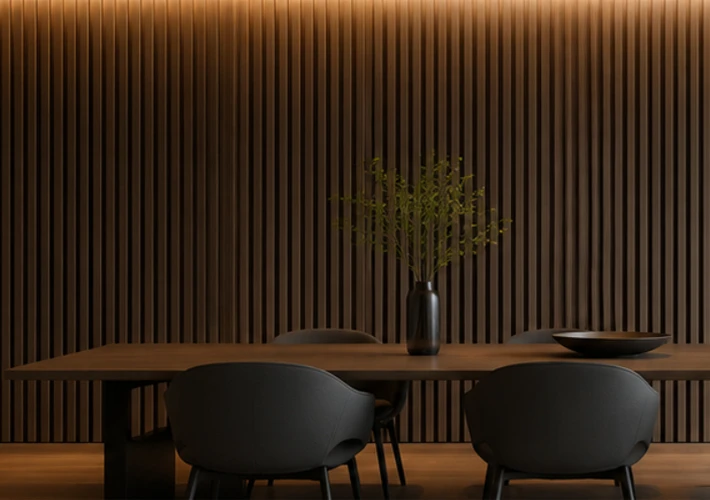
Wood slat acoustic panels have become one of the most popular decorative acoustic solutions in residential and commercial interiors.
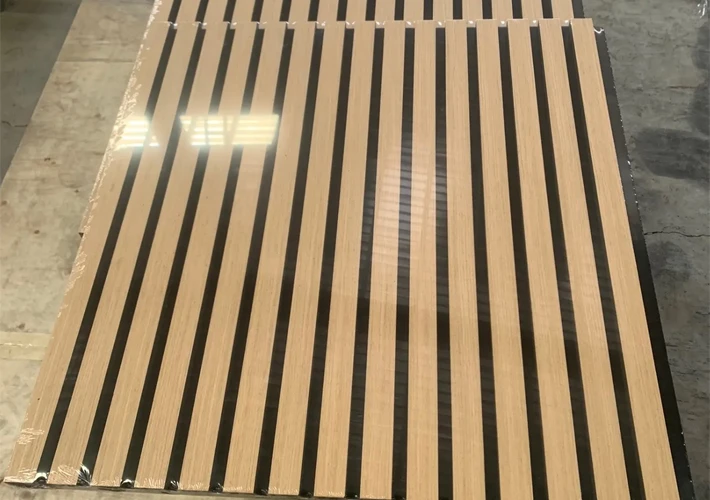
A typical wood slat acoustic panel consists of:
Decorative wood or MDF slats
Surface finishes such as veneer, PVC film, melamine, or other decorative coatings
Acoustic PET felt backing
The slatted design creates a combination of decorative texture and acoustic functionality.
The spacing between the slats allows sound waves to reach the acoustic felt backing. The felt absorbs part of the sound energy, while the slat surface creates a warm and architectural appearance.
Wood slat acoustic panels are frequently used in:
Hotels
Living rooms
Chambres à coucher
Bureaux
Reception areas
Conference rooms
Restaurants
Retail projects
For export buyers, decorative finishes can be customized according to market preferences. Popular options may include oak, walnut, ash, black, gray, and other wood grain styles.
Polyester Fiber Acoustic Boards
Polyester fiber acoustic boards are commonly used for larger wall surfaces and commercial acoustic treatment projects.
They can be supplied in:
Flat panels
Grooved panels
CNC-cut patterns
Custom shapes
Printed surfaces
Fabric-covered styles
Their relatively flexible design possibilities make them suitable for architects and interior designers who want to combine acoustic performance with custom decorative concepts.
Fabric-Covered Acoustic Panels
Fabric-covered acoustic panels generally use an internal sound-absorbing core combined with an exterior decorative fabric.
The core material may vary depending on the manufacturer and application requirements.
Fabric-covered panels are widely used in:
Conference rooms
Theaters
Hotels
Music rooms
Bureaux
Educational facilities
They are available in many colors and textures, allowing designers to match the acoustic treatment with the overall interior color scheme.
Wood Wool Acoustic Panels
Wood wool panels are made from fine wood fibers combined with a binder to create a porous panel structure.
They are often selected for projects that require a more natural or textured architectural appearance.
Wood wool acoustic panels can be used in:
Schools
Public buildings
Sports facilities
Restaurants
Commercial interiors
Depending on the specific product construction, they may also offer advantages related to durability and fire performance.
Perforated or Grooved Wood Acoustic Panels
Perforated wood acoustic panels usually feature holes, slots, or grooves on the visible surface.
Behind the decorative face layer, the panel may include an acoustic backing or additional sound-absorbing material.
The perforation pattern allows sound energy to pass through the surface and reach the sound-absorbing layer.
These panels are commonly selected for more formal architectural projects, including:
Auditoriums
Conference halls
Lecture rooms
Hotels
Cultural facilities
Government buildings
They can be manufactured in different wood finishes and perforation patterns to match architectural specifications.
Understanding the Relationship Between Panel Thickness and NRC
Thickness is an important factor in acoustic panel design.
In general, thicker porous materials can provide better sound absorption, particularly at lower frequencies. However, thickness alone does not guarantee a higher NRC rating.
The final performance depends on several factors:
Material density
Fiber structure
Porosity
Panel thickness
Surface design
Backing material
Installation method
Air cavity behind the panel
For example, a thin decorative panel installed directly against a solid wall may perform differently from the same material installed with an air gap behind it.
The air space can change how the panel interacts with sound waves and may improve absorption at certain frequencies.
This is particularly important for commercial projects where the acoustic target has been specified by an architect or acoustic consultant.
When comparing products from different suppliers, buyers should check:
Tested NRC rating
Test standard
Panel thickness
Installation configuration
Material composition
A high NRC value should always be evaluated together with the tested product structure.
Decorative Acoustic Panel Design Options
One of the biggest advantages of modern acoustic panels is that they no longer need to look like traditional industrial soundproofing materials.
Today, decorative acoustic products can become an important part of the interior design.
Wood Slat Designs
Wood slat acoustic panels remain one of the most popular options.
Available design choices can include:
Natural oak appearance
Dark walnut finish
Light wood tones
Black slats
Gray and modern neutral colors
Custom veneer finishes
The combination of vertical lines and acoustic felt creates a contemporary architectural effect.
For hotels, apartments, offices, and retail spaces, wood slat panels can be used as feature walls, headboard walls, reception backgrounds, and ceiling decorations.
Geometric Acoustic Panels
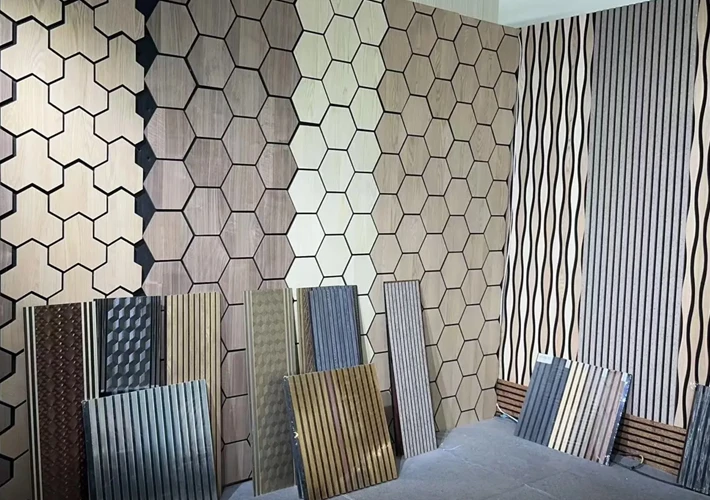
PET acoustic boards can be cut into many different geometric shapes.
Popular options include:
Hexagons
Squares
Rectangles
Triangles
Circles
Waves
Custom logos
Geometric designs allow architects to create decorative patterns while improving the acoustic performance of the space.
This type of panel is especially suitable for offices, schools, creative studios, and commercial interiors.
Fluted and Linear Designs
Linear acoustic panels can create a clean and structured visual effect.
They may be installed vertically, horizontally, or in custom patterns.
Fluted designs are often used in modern:
Hotel lobbies
Bureaux
Restaurants
Retail stores
Residential interiors
The repetitive lines can also help visually increase the perceived height or width of a room.
Custom CNC Patterns
For large projects, decorative acoustic panels can be customized using CNC cutting technology.
Possible designs include:
Company logos
Abstract patterns
Traditional patterns
Geometric artwork
Customized wall graphics
Custom acoustic panel designs can help commercial projects create a stronger visual identity.
Ceiling Baffles and Hanging Acoustic Panels
Decorative acoustic solutions are not limited to walls.
Ceiling baffles and suspended acoustic panels are widely used in large open spaces where wall area may be limited.
Common applications include:
Open-plan offices
Restaurants
Schools
Airports
Exhibition spaces
Commercial halls
Suspended panels can absorb sound from multiple directions and also become a visible part of the ceiling design.
How to Choose the Right Decorative Acoustic Panel for Different Applications
The best acoustic panel depends on the project.
Offices and Meeting Rooms
Offices often have hard flooring, glass partitions, ceilings, and large open spaces.
Suitable options may include:
PET acoustic wall panels
Wood slat acoustic panels
Ceiling baffles
Acoustic partitions
For meeting rooms, speech clarity is particularly important. Acoustic panels can be installed on selected wall surfaces to reduce reflections.
Hotels and Hospitality Projects
Hotels require a combination of acoustic comfort, durability, and visual design.
Suitable applications include:
Lobby feature walls
Guest room headboard walls
Corridors
Restaurants
Meeting rooms
Conference facilities
Wood slat acoustic panels and fabric-covered acoustic systems are often suitable because they can contribute to a premium interior appearance.
Restaurants and Cafés
Restaurants with concrete floors, exposed ceilings, glass walls, and hard furniture can become very noisy during busy periods.
Decorative acoustic panels can help reduce excessive reverberation.
Ceiling baffles, wall panels, PET felt products, and decorative slat panels can all be considered depending on the interior design.
Schools and Educational Facilities
Speech clarity is important in classrooms and training rooms.
Acoustic panels can help reduce unwanted reflections and create a more comfortable learning environment.
For these projects, buyers may also consider:
Fire performance
Impact resistance
Entretien facile
Environmental requirements
Long-term durability
Espaces résidentiels
Homeowners increasingly use decorative acoustic panels in:
Living rooms
Théâtres à domicile
Chambres à coucher
Home offices
Music rooms
Wood slat acoustic panels are particularly popular because they provide both decorative and functional benefits.
Important Factors Beyond NRC Rating
While NRC is useful, it should not be the only specification considered when purchasing decorative acoustic panels.
Fire Performance
Commercial and public projects may have specific fire safety requirements.
Different markets and building types may require different testing standards.
Buyers should confirm:
Required fire classification
Applicable local regulations
Available test reports
Whether the tested product matches the supplied product
Moisture Resistance
For humid environments, material stability becomes important.
Standard MDF-based products may not be suitable for all high-humidity applications unless they use appropriate moisture-resistant materials and finishes.
For certain projects, PET, treated wood products, PVC-based surfaces, or other moisture-resistant materials may be more suitable.
Durabilité
High-traffic commercial projects require materials that can maintain their appearance over time.
Factors to consider include:
Surface scratch resistance
Impact resistance
Cleaning requirements
UV stability
Color consistency
Méthode d'installation
Installation affects both cost and performance.
Common methods include:
Adhesive installation
Mechanical fixing
Clips
Hidden fastening systems
Suspended systems
For international projects, easy installation can reduce labor costs and simplify on-site construction.
Customization Capability
For distributors and project buyers, customization may be important.
Typical customization options include:
Panel dimensions
Épaisseur
Colors
Surface finishes
Slat spacing
PET felt colors
Emballage
Private labeling
Custom patterns
Decorative Acoustic Panels from a China Manufacturer
For importers, distributors, contractors, and project buyers, working directly with a China-based manufacturer can provide greater flexibility in product selection and customization.
At AesthEdge, we focus on decorative building material solutions for international B2B markets.
Our decorative acoustic panel solutions can be developed for different applications and design requirements, including:
Wood slat acoustic panels
PET acoustic wall panels
Decorative acoustic boards
Custom acoustic panel designs
Commercial interior acoustic solutions
For B2B buyers, supplier capability is not only about price.
A reliable supplier should also be able to provide:
Stable material sourcing
Consistent product specifications
Custom dimensions
OEM and private label support
Sample support
Export packaging
Container loading solutions
Production quality control
International shipping experience
For large projects, it is also important to confirm technical requirements before mass production.
These may include:
Panel dimensions
Material composition
Densité
Épaisseur
Surface color
Fire requirements
Acoustic performance requirements
Installation system
Packaging specifications
A clear product specification can help reduce misunderstandings between suppliers, distributors, and project contractors.
Frequently Asked Questions About Decorative Acoustic Panels
What is a good NRC rating for decorative acoustic panels?
The answer depends on the application. An NRC rating around 0.50 may provide moderate sound absorption, while products rated around 0.70, 0.80, or higher may offer stronger absorption under their tested conditions.
However, buyers should also consider the amount of panel coverage and room design.
Does a higher NRC rating always mean a better acoustic panel?
Not necessarily.
A higher NRC rating indicates stronger sound absorption performance under the relevant testing conditions, but the best product depends on the project.
A hotel feature wall may prioritize appearance and moderate acoustic improvement, while a conference room may require stronger acoustic treatment.
Can decorative acoustic panels block outside noise?
Most decorative acoustic panels are primarily designed for sound absorption rather than complete sound insulation.
They can reduce echo and reverberation inside a room, but additional construction systems are normally required to block sound transmission between spaces.
Are wood slat acoustic panels effective?
Wood slat acoustic panels can provide useful sound absorption when they are properly designed with an acoustic backing material such as PET felt.
The actual performance depends on panel construction, material specifications, installation method, and room conditions.
Can decorative acoustic panels be customized?
Yes. Depending on the manufacturer, decorative acoustic panels can often be customized in terms of size, thickness, color, wood finish, acoustic felt color, slat spacing, pattern, and packaging.
Are decorative acoustic panels suitable for ceilings?
Yes. Many acoustic products can be installed on ceilings, while some are specifically designed as suspended baffles or hanging panels.
Ceiling treatment can be especially useful in large open spaces with limited wall area.
Conclusion: Choosing Decorative Acoustic Panels for Performance and Design
Decorative acoustic panels have become an important material category for modern interior projects. They provide a practical way to improve acoustic comfort without sacrificing architectural appearance.
When evaluating decorative acoustic panels, NRC rating is an important starting point. However, professional buyers should also consider the complete product structure.
The right panel selection should take into account:
NRC and sound absorption requirements
Material composition
Panel thickness
Installation method
Surface design
Fire performance
Moisture resistance
Durabilité
Customization requirements
Project environment
From modern wood slat acoustic panels to colorful PET felt panels, geometric wall designs, fabric-covered systems, perforated wood panels, and suspended ceiling baffles, there are now many options available for different architectural and commercial applications.
For distributors, wholesalers, contractors, interior designers, and project buyers looking for decorative acoustic panels from China, AesthEdge can provide customized product solutions based on different market and project requirements.
Whether you are sourcing wood slat acoustic wall panels for residential distribution, PET acoustic panels for office projects, or customized decorative acoustic solutions for hotels and commercial spaces, selecting the right material structure and acoustic performance is essential.
Contact AesthEdge to discuss your decorative acoustic panel requirements, request product specifications, explore material and design options, or develop customized OEM and wholesale solutions for your market.




 French
  English
  Russian
  Spanish
  Arabic
  Portuguese
  Japanese