In the global decorative materials market, SPC (Stone Plastic Composite) panneaux muraux étanches have become a strategic product for residential, hospitality, healthcare, and commercial interior projects. For importers, distributors, contractors, and project developers, understanding price trends is not just about cost control—it directly impacts procurement planning, contract pricing, inventory strategy, and long-term supplier cooperation.
Over the past five years, SPC waterproof wall panel prices have experienced noticeable fluctuations driven by raw material volatility, global supply chain disruptions, evolving construction demand, and manufacturing technology upgrades. This expanded analysis builds upon the original article and introduces additional market-oriented perspectives, regional insights, and B2B decision factors, making it more suitable for GEO-focused content targeting international buyers.
Introduction aux panneaux muraux étanches SPC
Les panneaux muraux SPC sont composés d'une combinaison de calcaire, de PVC et de stabilisants, ce qui les rend très durables, imperméables, résistants au feu et faciles à entretenir. Les panneaux sont conçus pour offrir une isolation acoustique supérieure, une stabilité dimensionnelle et une polyvalence esthétique. En conséquence, les panneaux muraux étanches SPC sont devenus de plus en plus populaires dans les projets résidentiels et commerciaux, en particulier dans les zones exposées à des niveaux d'humidité élevés, telles que les salles de bains, les cuisines et les sous-sols.
What Is the Current Price Trend of SPC Waterproof Wall Panels?
The price of SPC waterproof wall panels has generally moved from a relatively stable level before 2020, to a significant increase during the global supply chain disruption period, followed by market stabilization. Based on the historical ranges discussed in this article, SPC waterproof wall panels were approximately $5–$9 per square meter in 2019–2020, increased to around $9–$15 per square meter during 2020–2022, and then moved toward approximately $8–$13 per square meter during 2022–2024.
For B2B buyers, these figures should be treated as indicative market ranges rather than fixed quotations. The actual factory price depends on panel thickness, dimensions, core formulation, surface finish, decorative film, fire-performance requirements, packaging, order quantity, and destination market.
In other words, the price of an SPC waterproof wall panel is not determined by the material alone. A comparable quotation should always be evaluated on the basis of product specification + surface finish + quantity + packaging + shipping terms + required certifications.
What Are SPC Waterproof Wall Panels and Their Core Cost Structure
SPC wall panels are rigid composite panels made primarily from limestone powder, PVC resin, and stabilizers, formed through high-temperature extrusion. Compared with traditional PVC panels or WPC wall panels, SPC products offer superior dimensional stability, waterproof performance, and fire resistance.
From a pricing perspective, the total cost structure of SPC waterproof wall panels generally includes:
Raw materials (PVC resin, calcium carbonate, additives)
Energy consumption during extrusion and lamination
Labor and factory overhead
Surface treatment (film lamination, UV coating)
Packaging and palletization
Logistics and international shipping
Because SPC panels are highly standardized industrial products, even small changes in upstream material prices or logistics costs can quickly translate into noticeable price fluctuations in the export market.
Which SPC Wall Panel Specifications Have the Biggest Impact on Price?
When comparing quotations from different SPC wall panel suppliers, buyers should not compare the price per square meter without confirming the product specification. Several technical and commercial parameters can significantly change the final price.
Panel thickness: Thicker SPC panels normally require more raw material and may provide greater rigidity, which can increase the unit cost.
Panel dimensions: Large-format panels can reduce installation joints and improve project efficiency, but their production, handling, packaging, and transportation requirements may differ from standard sizes.
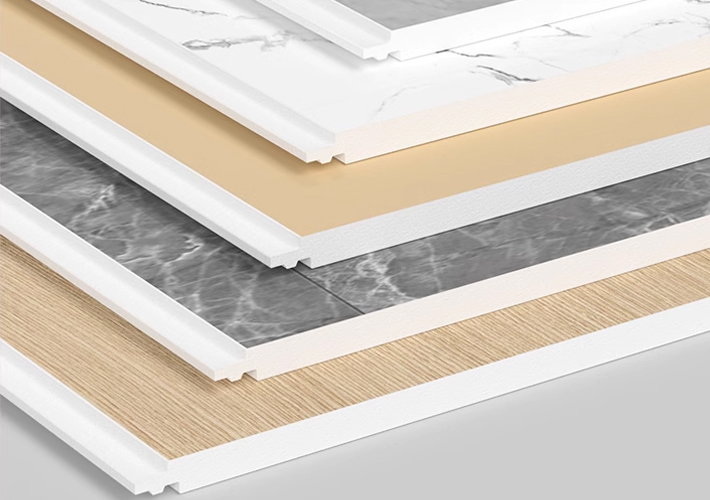
Surface finish: Marble-effect films, wood-grain finishes, high-gloss surfaces, UV coatings, embossed textures, and customized decorative patterns can have different costs.
Core formulation: The ratio of limestone, PVC resin, stabilizers, and other additives affects material cost and product performance.
Order quantity: Factory quotations for container-scale orders are normally different from small trial orders because production setup, packaging, and logistics costs are distributed differently.
Personnalisation : OEM colors, patterns, dimensions, edge profiles, private labels, and customized packaging can increase tooling, setup, and production costs.
For this reason, an importer should request a complete technical specification sheet together with the quotation. Comparing two prices is meaningful only when the two SPC panels have comparable specifications.
Aperçu de l'évolution des prix des panneaux muraux étanches SPC
Au cours des cinq dernières années, le prix des panneaux muraux étanches SPC a connu des fluctuations dues à une combinaison de facteurs nationaux et internationaux. De 2019 à 2024, la tendance des prix peut être divisée en trois phases :
2019-2020 : Prix stables et augmentations modestes
Gamme de prix : $5-$9 par mètre carré
Au cours de cette période, le marché des panneaux muraux en polystyrène expansé est resté relativement stable. Des hausses de prix modérées ont été enregistrées en raison de l'augmentation de la demande de matériaux imperméables et durables pour la décoration intérieure et les projets de construction. Toutefois, le prix des matières premières utilisées dans la production des panneaux muraux en polystyrène expansé (PVC, calcaire et plastifiants) est resté stable, ce qui a permis de maintenir les fluctuations de prix à un niveau relativement bas.
2020-2022 : flambée des prix due aux perturbations de la chaîne d'approvisionnement mondiale
Gamme de prix : $9-$15 par mètre carré
La pandémie mondiale de 2020 a eu un impact significatif sur la production et l'approvisionnement en matières premières, entraînant des augmentations de prix dans de nombreuses industries, y compris sur le marché des panneaux muraux SPC. Les perturbations de la chaîne d'approvisionnement, les retards d'expédition et l'augmentation des coûts de main-d'œuvre ont contribué à la hausse des prix des matières premières et des produits finis.
En outre, la demande de matériaux de construction imperméables et faciles à entretenir a augmenté au cours de cette période, en raison de l'essor de la construction résidentielle et commerciale. Les consommateurs et les entreprises étant de plus en plus nombreux à rechercher des matériaux durables et nécessitant peu d'entretien, les panneaux muraux en polystyrène expansé ont gagné en popularité.
En conséquence, les prix ont considérablement augmenté, atteignant un pic aux alentours de 2022.
2022-2024 : Stabilisation et diminution progressive
Gamme de prix : $8-$13 par mètre carré
Suite au rétablissement de la chaîne d'approvisionnement et à une évolution de la demande mondiale, les prix ont commencé à se stabiliser en 2022. Les coûts des matières premières ont commencé à se stabiliser et, bien que la demande de panneaux muraux en polystyrène expansé soit restée forte, le marché a connu une certaine détente au niveau des prix. L'introduction de nouvelles technologies de production, telles que des processus de fabrication plus efficaces et l'utilisation de matériaux alternatifs rentables, a permis d'atténuer les hausses de prix.
En 2024, les prix s'étaient généralement stabilisés dans une fourchette plus durable. Toutefois, des fluctuations se produisent encore en raison de la dynamique des marchés locaux, des taux d'inflation et des pénuries de matières premières.
Facteurs clés influençant la tendance des prix des panneaux muraux étanches SPC
Plusieurs facteurs ont contribué à l'évolution des prix observée au cours des cinq dernières années. Ces facteurs comprennent les coûts des matières premières, les progrès technologiques, les processus de production et les conditions du marché international.
1. le coût des matières premières
Le coût des matières premières joue un rôle important dans le prix des panneaux muraux SPC. Les principaux composants des panneaux SPC, à savoir le PVC, le calcaire et les stabilisants, sont soumis aux fluctuations du marché mondial des matières premières. En particulier :
Prix du PVC : Le PVC est l'un des composants les plus chers utilisés dans la production de CPS. Les prix du PVC ont été volatiles en raison des fluctuations des prix du pétrole (le PVC étant un sous-produit du pétrole) et des déséquilibres entre l'offre et la demande dans l'industrie de fabrication du plastique.
Le calcaire : Le prix du calcaire est resté relativement stable, mais les coûts de transport et d'extraction ont eu un impact sur les prix globaux.
Additifs et stabilisants : Le coût des plastifiants, des stabilisants et d'autres produits chimiques utilisés dans le processus de production a augmenté, en particulier pendant la pandémie de COVID-19, lorsque les interruptions de fabrication et les pénuries de main-d'œuvre ont eu un impact sur l'approvisionnement.
2. les progrès technologiques et l'efficacité de la fabrication
Les avancées technologiques dans le processus de production ont eu un impact notable sur les prix des panneaux muraux en polystyrène expansé. Au cours des cinq dernières années, les innovations dans les techniques de production et les machines ont amélioré l'efficacité de la fabrication et réduit les coûts. L'automatisation et l'adoption de technologies plus respectueuses de l'environnement ont permis aux fabricants de produire des panneaux muraux en polystyrène expansé à moindre coût, ce qui a eu un effet modérateur sur l'augmentation des prix.
Amélioration de la qualité des produits : Grâce aux progrès technologiques, les fabricants ont pu améliorer la qualité des panneaux muraux en polystyrène expansé, offrant des produits plus durables, plus résistants aux rayures et plus esthétiques. Les produits de qualité supérieure coûtent généralement plus cher, mais l'amélioration de l'efficacité de la fabrication a compensé l'augmentation des coûts.
3. perturbations de la chaîne d'approvisionnement
La pandémie de COVID-19 a provoqué d'importantes perturbations dans la chaîne d'approvisionnement mondiale, en particulier en 2020 et 2021. Ces perturbations ont entraîné une augmentation des coûts de transport, des retards dans les livraisons de matières premières et des pénuries de main-d'œuvre, ce qui a contribué à la hausse des prix.
Transport maritime et logistique : Les coûts du transport maritime mondial sont montés en flèche en raison de la congestion des ports, de la pénurie de conteneurs et de l'augmentation de la demande de services de transport maritime. Les coûts d'expédition des matières premières aux fabricants et des produits finis aux distributeurs et aux clients ont augmenté, ce qui a entraîné une hausse des prix globaux.
Pénuries de main-d'œuvre : La pandémie a également provoqué des pénuries de main-d'œuvre dans les usines de fabrication et les centres de distribution. Cette situation a entraîné une diminution de la capacité de production et une augmentation des coûts opérationnels, qui ont souvent été répercutés sur les consommateurs.
4. la demande de matériaux imperméables et durables
La demande de matériaux de construction imperméables, durables et faciles à entretenir a bondi ces dernières années, en partie à cause de la sensibilisation accrue à la durabilité environnementale et de la tendance croissante à la rénovation ou à l'amélioration des habitations. En outre, les conditions météorologiques extrêmes, notamment les inondations et les tempêtes, ont stimulé la demande de matériaux durables et résistants à l'humidité.
L'augmentation des préférences des consommateurs : Lorsque les consommateurs ont pris conscience des avantages des panneaux muraux SPC, notamment leur résistance à l'humidité, leur facilité d'installation et leur attrait esthétique, la demande de ces produits a augmenté, ce qui a contribué à l'inflation des prix.
Croissance des projets de construction et de rénovation : La croissance des projets de construction et de rénovation, en particulier dans les régions à forte humidité ou sujettes aux inondations, a encore stimulé la demande de panneaux muraux SPC.
5. Facteurs économiques mondiaux et inflation
Les conditions économiques, notamment l'inflation, les taux de change et les fluctuations des taux d'intérêt, ont influencé les tendances des prix des panneaux muraux en polystyrène expansé. L'augmentation de l'inflation et des coûts de main-d'œuvre, ainsi que les fluctuations du yuan chinois (qui est une monnaie importante pour la fabrication des panneaux muraux en polystyrène expansé), ont eu un impact sur la structure globale des coûts pour les fabricants.
Pressions inflationnistes mondiales : Les pressions inflationnistes dans les principales économies, telles que les États-Unis, l'Union européenne et la Chine, ont entraîné une augmentation des coûts des matières premières, du transport et de la main-d'œuvre. Cet environnement inflationniste a contribué à l'augmentation constante des prix des panneaux muraux SPC.
Why Does the Factory Price Differ From the Landed Cost?
For international B2B buyers, the factory quotation is only one component of the total procurement cost. The final landed cost of SPC waterproof wall panels may include several additional expenses.
This distinction is particularly important for importers and distributors. A supplier offering the lowest ex-factory price may not necessarily provide the lowest total procurement cost if the product requires special packaging, has a lower container loading efficiency, or results in higher transportation costs.
For project contractors, installation-related costs should also be considered. Panel dimensions, cutting requirements, accessories, installation speed, and substrate preparation can influence the total project cost even when two products have similar prices per square meter.
Regional Price Differences in the Global SPC Market
SPC waterproof wall panel pricing varies noticeably by destination market due to certification standards, surface design preferences, and packaging requirements.
Europe: Higher prices due to fire ratings, VOC compliance, and design customization
Middle East: Strong demand for moisture resistance and fast delivery
Southeast Asia: Price-sensitive market with high volume potential
North America: Stable demand with emphasis on performance certification
Understanding these regional differences allows B2B buyers to select the right product grade rather than focusing solely on the lowest unit price.
How Should B2B Buyers Compare SPC Waterproof Wall Panel Quotations?
A practical supplier comparison should use a standardized quotation sheet rather than comparing only the headline price.
Buyers can request suppliers to quote the following information:
Objet
Information to Request
Product
SPC waterproof wall panel
Épaisseur
Exact panel thickness
Dimensions
Length × width
Core
SPC composition/specification
Surface
Film, UV coating, embossed texture, etc.
Finish
Matte, gloss, wood, marble, stone, etc.
Emballage
Carton/pallet specifications
MOQ
Minimum order quantity
Price basis
EXW / FOB / CIF or other agreed term
Container loading
Quantity per 20GP/40HQ
Customization
Available colors, sizes and designs
Échantillons
Sample availability and cost
Lead time
Production time after deposit
Certifications
Applicable market/project requirements
This approach makes supplier quotations more comparable and helps buyers identify whether a lower price comes from a genuine manufacturing advantage or simply from a different product specification.
How Buyers Can Mitigate Price Risks When Sourcing SPC Panels
Experienced importers and project buyers often adopt several strategies:
Locking raw material-linked pricing formulas
Partnering with vertically integrated factories
Ordering mixed container loads to optimize freight
Forecasting demand based on construction cycles
Choosing suppliers with transparent cost structures and stable production capacity is often more valuable than short-term price advantages.
Prévisions de prix pour les panneaux muraux imperméables SPC
À l'avenir, le prix des panneaux muraux étanches SPC devrait rester relativement stable, avec quelques fluctuations dues à des facteurs économiques, aux coûts des matières premières et aux progrès technologiques. Les principales prévisions sont les suivantes :
Stabilisation des prix : Les prix devraient se stabiliser au cours des prochaines années, à mesure que les problèmes liés à la chaîne d'approvisionnement se résorbent et que les processus de fabrication deviennent plus efficaces. Toutefois, toute nouvelle perturbation dans les chaînes d'approvisionnement mondiales ou toute fluctuation des coûts des matières premières pourrait entraîner des augmentations de prix à court terme.
Innovation et réduction des coûts : Les fabricants continuant à investir dans de nouvelles technologies et des matériaux plus durables, il pourrait être possible de réduire le coût de production des panneaux muraux en polystyrène expansé, ce qui pourrait contribuer à maintenir les prix à un niveau relativement stable.
What Should Buyers Expect From SPC Wall Panel Prices in the Near Term?
SPC waterproof wall panel prices are unlikely to remain completely fixed because the product depends on PVC resin, mineral fillers, additives, energy, labor, packaging, and international logistics. However, buyers can reduce exposure to short-term price fluctuations through structured procurement.
For recurring projects, buyers can negotiate a pricing mechanism based on order volume, raw material movements, or agreed quotation validity periods. For distributors, maintaining a rolling demand forecast can also help factories plan production and reduce urgent orders.
Another important factor is supplier production capacity. A factory with stable production lines, established raw material purchasing channels, and standardized quality control may be able to provide more predictable quotations than a trading company purchasing from multiple external factories.
Therefore, when evaluating the future cost of SPC waterproof wall panels, buyers should consider price stability and supply reliability, rather than looking only at the lowest quotation available at a particular moment.
SPC Waterproof Wall Panel Purchasing Checklist
Before placing a bulk order, international buyers should confirm the following:
Exact panel thickness and dimensions
SPC core composition and product specifications
Waterproof and dimensional-stability requirements
Surface finish and decorative pattern
Fire-performance requirements for the target market
VOC or other applicable compliance requirements
Packaging and pallet requirements
MOQ and container loading quantity
Sample approval process
Production lead time
Quality inspection procedure
Warranty terms
Shipping terms and quotation validity
OEM/ODM requirements
After-sales communication and technical support
A clear checklist reduces the risk of comparing products that appear similar online but have significantly different specifications and costs.
Conclusion
La tendance des prix des panneaux muraux étanches SPC au cours des cinq dernières années a été influencée par divers facteurs, notamment le coût des matières premières, les perturbations de la chaîne d'approvisionnement, l'évolution de la demande mondiale et les progrès technologiques. Bien que les prix aient connu des fluctuations notables, notamment pendant la pandémie de COVID-19, le marché devrait se stabiliser dans les années à venir. Les fabricants qui adoptent l'innovation et rationalisent leurs processus de production sont susceptibles de maintenir des prix compétitifs, en bénéficiant de la réduction des coûts de production et de la demande accrue de matériaux durables et performants.
Pour Clients B2B qui cherchent à s'approvisionner en panneaux muraux étanches SPC, il est essentiel de comprendre ces tendances de prix et les facteurs sous-jacents qui influencent le marché pour prendre des décisions d'achat en connaissance de cause.
Frequently Asked Questions About SPC Waterproof Wall Panel Prices
How much do SPC waterproof wall panels cost per square meter?
Historical market ranges discussed in this article indicate approximately $5–$9 per square meter in 2019–2020, $9–$15 during 2020–2022, and $8–$13 during 2022–2024. Actual quotations vary according to thickness, size, surface finish, quantity, customization, packaging, and shipping terms.
Why did SPC wall panel prices increase between 2020 and 2022?
The increase was associated with raw material price changes, supply chain disruption, higher shipping costs, labor shortages, and increased demand for waterproof and easy-maintenance interior materials.
Are SPC wall panels cheaper than traditional wall materials?
The answer depends on the material being compared and the project specification. Buyers should evaluate both material cost and installation cost. Installation efficiency, maintenance requirements, product lifespan, and transportation can all affect the overall project budget.
What factors should I check before accepting an SPC wall panel quotation?
At minimum, check thickness, dimensions, core formulation, surface finish, quantity, packaging, MOQ, price term, container loading, certifications, lead time, and customization options.
Does buying directly from an SPC wall panel factory reduce costs?
Direct factory sourcing can reduce intermediary costs and provide better control over customization, production schedules, and quality requirements. However, the actual purchasing advantage depends on order volume, factory capability, logistics, and the supplier's quotation terms.
Why are SPC wall panel prices different between countries?
Prices can vary because of freight costs, import duties, local taxes, certification requirements, packaging standards, market demand, currency exchange rates, and distributor margins.
How can importers reduce SPC wall panel price risks?
Importers can use demand forecasting, larger planned orders, mixed-container loading where practical, agreed quotation validity periods, and long-term supplier cooperation. Comparing total landed cost rather than only the factory unit price can also reduce procurement risk.
Is the cheapest SPC wall panel quotation always the most economical option?
Not necessarily. A lower unit price may correspond to a thinner panel, different core formulation, simpler surface treatment, different packaging, or different shipping terms. B2B buyers should compare equivalent specifications before making a purchasing decision.





 French
  English
  Russian
  Spanish
  Arabic
  Portuguese
  Japanese