For commercial interiors, wall materials need to balance appearance, installation efficiency, durability, and project cost. WPC の壁パネル have become an increasingly practical option for hotels, offices, restaurants, retail stores, lobbies, corridors, and other commercial spaces. Compared with traditional decorative wall materials, WPC panels can provide a wood-inspired appearance while offering convenient processing and relatively efficient installation.
However, achieving a professional result depends heavily on correct cutting, substrate preparation, fixing methods, joint treatment, and project planning. For contractors, distributors, architects, and commercial project buyers, understanding the complete installation process is essential before placing a bulk order.
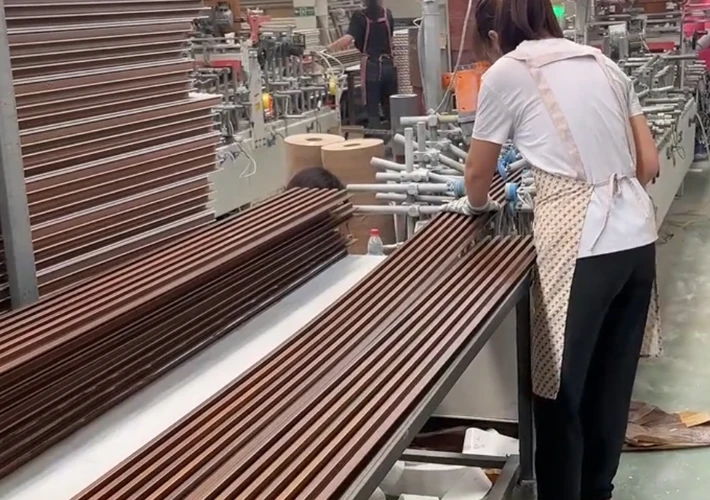
As a China WPC wall panel factory, エースエッジ supplies WPC decorative wall panels for commercial and hospitality projects, with options for different profiles, dimensions, colors, textures, and applications. This guide explains how to cut and install WPC wall panels and highlights the key points that commercial buyers should consider when planning a project.
What Are WPC Wall Panels?
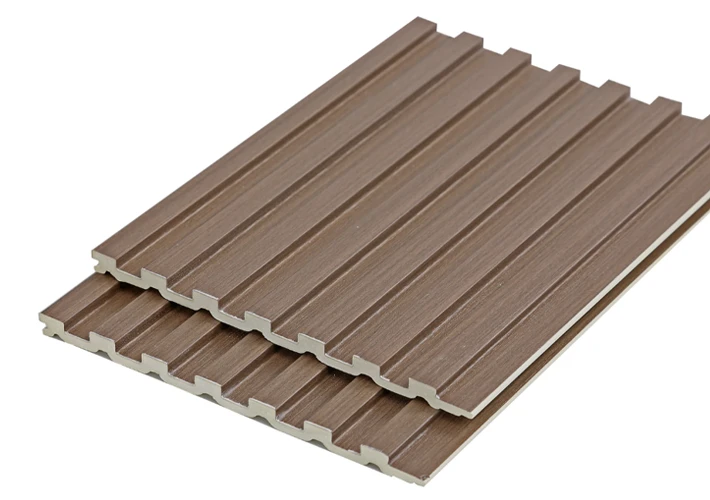
WPC stands for Wood Plastic Composite. WPC wall panels are decorative wall materials manufactured using a composite formulation that combines wood-based material with polymer and other additives. Depending on the product structure and manufacturing process, the finished panel can be produced in different profiles, textures, colors, and surface finishes.
Commercial WPC wall panels are commonly used for:
Hotel feature walls
Hotel corridors
Restaurant interiors
Office reception areas
Retail stores
Commercial lobbies
Residential developments
Entertainment venues
Meeting rooms
Display areas
Interior feature walls
Ceiling and decorative applications
One reason WPC panels are attractive for commercial projects is their ability to create a warm, architectural appearance without requiring the same installation process as traditional solid wood decorative systems.
For B2B buyers, however, the most important consideration is not simply the appearance of a sample. The complete product specification should be evaluated, including panel dimensions, density, profile design, surface finish, color consistency, installation accessories, packaging, and batch stability.
Common WPC Wall Panel Profiles
Different commercial projects may require different visual effects. Typical WPC wall panel designs include:
パネルタイプ
Typical Application
Slat wall panel
Offices, hotels, restaurants, feature walls
Fluted WPC panel
Reception areas, lobbies, retail spaces
Great Wall panel
Feature walls and decorative interiors
Half-round panel
Decorative commercial interiors
Flat WPC panel
Large wall surfaces
Custom profile
Project-specific architectural designs
The correct profile should be selected according to the wall design, installation method, lighting conditions, and required visual effect.
What Tools Are Needed to Cut WPC Wall Panels?
One of the advantages of WPC wall panels is that they can generally be processed using commonly available woodworking or construction tools. Nevertheless, commercial contractors should use appropriate blades and cutting equipment to achieve clean edges and consistent dimensions.
Typical tools include:
メジャー
Pencil or marking tool
Spirit level or laser level
Circular saw
Table saw
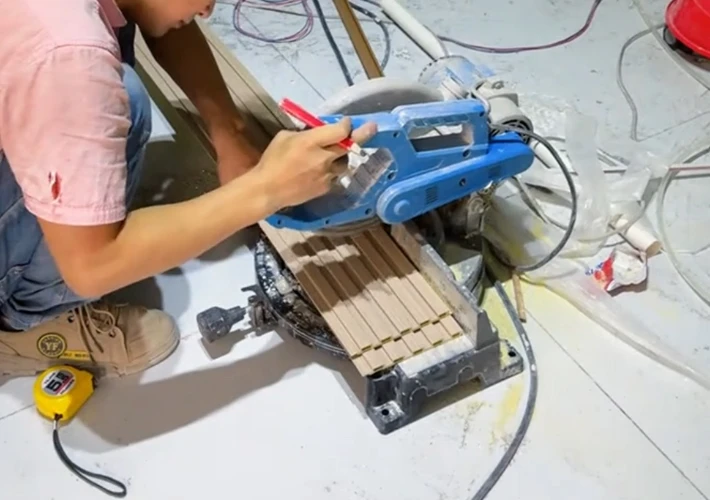
Miter saw
Fine-tooth saw blade
Drill
Screwdriver
Utility knife for certain accessories
Clamps
Sandpaper
Adhesive
Screws or fixing clips
Protective gloves
Safety glasses
Dust mask where required
For larger commercial projects, a miter saw or table saw can make repetitive cutting more efficient. Contractors working with large quantities should establish a standardized cutting process before beginning installation.
Choosing the Right Saw Blade
The cutting quality depends partly on the blade being used.
A fine-tooth blade is generally preferable when the project requires a clean decorative edge. A coarse blade may increase the risk of rough edges or surface damage.
Before processing hundreds of panels, installers should make several test cuts and inspect:
Edge smoothness
Surface chipping
Dimensional accuracy
Color or finish damage
Fit between adjacent panels
This simple test can help reduce material waste during large commercial installations.
Measure Twice, Cut Once
Accurate measurement is especially important when WPC panels are installed around:
Doors
Windows
Columns
Electrical outlets
Lighting fixtures
HVAC equipment
Corners
Decorative openings
Before cutting, measure the required dimension and mark the cutting line clearly. For repetitive panels, creating a cutting template can improve consistency.
Commercial projects often involve hundreds or thousands of square meters of decorative materials. A small cutting error repeated across a large quantity can create significant material waste and additional labor costs.
How to Prepare the Wall Before Installation
Proper substrate preparation is one of the most important steps in WPC wall panel installation.
WPC panels should not be expected to correct major problems in the underlying wall. If the substrate is uneven, wet, contaminated, or structurally unsuitable, the finished wall may show alignment problems or installation defects.
1. Check the Wall Flatness
Use a spirit level or laser level to check the wall.
Small irregularities may be manageable depending on the installation system, but major unevenness should be corrected before installation.
For commercial projects, contractors should establish acceptable substrate tolerances in advance.
2. Clean the Surface
Remove:
Dust
Loose particles
Oil
Construction debris
Peeling paint
Other contaminants
A clean substrate improves adhesive performance when adhesive installation is being used.
3. Check for Moisture Problems
The wall should be sufficiently dry and free from active water leakage.
If there is an underlying moisture problem, it should be resolved before decorative wall materials are installed. Covering a moisture issue with a decorative panel does not solve the source of the problem.
4. Mark the Installation Lines
Use a laser level or chalk line to establish:
Starting position
Horizontal reference line
Vertical reference line
Panel boundaries
Corner positions
For a large hotel lobby or commercial wall, accurate reference lines can make the difference between a professional finished surface and visible alignment problems.
How to Cut WPC Wall Panels Step by Step
Once the wall and tools are ready, the panels can be measured and cut according to the installation layout.
Step 1: Confirm the Layout
Do not begin cutting randomly.
First determine:
Where the first panel starts
Where the final panel ends
How corners will be treated
Where doors and windows are located
How electrical openings will be positioned
Whether symmetrical patterns are required
For feature walls, the layout should be finalized before large-scale cutting begins.
Step 2: Measure the Required Length
Measure the actual installation location rather than relying only on architectural drawings.
Construction dimensions can vary from the original design drawings because of:
Wall tolerances
Flooring thickness
Ceiling conditions
Door frames
On-site modifications
Step 3: Mark the Cutting Line
Use a pencil or suitable marking tool.
For visible decorative surfaces, make sure the cutting line is accurate and easy to follow.
Step 4: Secure the Panel
Place the WPC panel on a stable cutting surface and secure it properly.
The panel should not move during cutting. Unstable material can result in inaccurate cuts or damaged edges.
Step 5: Make the Cut
Use the appropriate saw and maintain a steady cutting speed.
Avoid forcing the saw through the panel. Let the blade perform the cutting work.
For repeated commercial cuts, installers can create a cutting jig or guide to improve dimensional consistency.
Step 6: Check the Edge
After cutting, inspect the edge.
If necessary, lightly smooth the edge with suitable sandpaper. Visible edges should receive particular attention because imperfections can remain noticeable after installation.
Step 7: Dry-Fit the Panel
Before permanently fixing the panel, place it in its intended position.
Check:
Length
Width
Alignment
Adjacent panel connection
Corner position
Openings
This step can prevent unnecessary removal and replacement after adhesive or mechanical fixing has been applied.
How to Install WPC Wall Panels for Commercial Projects
There are several installation approaches depending on the panel design, substrate, project requirements, and manufacturer recommendations.
The main approaches include:
Adhesive installation
Mechanical fixing
Batten or framing installation
Combined adhesive and mechanical fixing
The appropriate method should be confirmed according to the specific WPC panel construction and project conditions.
Method 1: Adhesive Installation
Adhesive installation can be suitable for relatively flat substrates.
Apply the recommended adhesive according to the adhesive manufacturer's instructions.
Position the panel carefully and press it against the substrate.
The first panel is especially important because it establishes the alignment for subsequent panels.
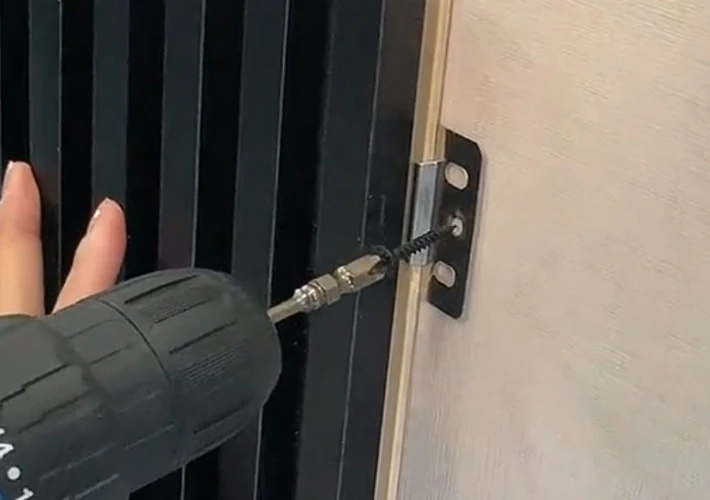
Method 2: Mechanical Fixing
Mechanical fixing can be useful where additional holding strength or a particular installation system is required.
Depending on the product design, installers may use:
Screws
Clips
Mounting profiles
Supporting battens
Fasteners should be positioned appropriately to avoid unnecessary damage to the visible surface.
Method 3: Battens or Framing
For uneven walls or projects requiring a service cavity, a supporting framework can be installed before the WPC panels.
This method can help:
Correct wall irregularities
Create installation space
Route cables
Improve alignment
Support specific panel systems
However, the framework dimensions should be designed according to the panel profile and fixing requirements.
Why the First Panel Matters
The first panel determines the alignment of the entire wall.
If the first panel is installed out of level, subsequent panels can gradually amplify the error.
For large commercial walls, contractors should therefore spend additional time establishing the starting line.
Using a laser level is often helpful for maintaining consistent alignment across long walls.
How to Handle Corners, Joints, Doors and Openings
Commercial wall installations often become more complicated around architectural details.
Internal Corners
Internal corners can be handled using:
Matching WPC accessories
Trim profiles
Custom-cut panels
Appropriate corner joining methods
The selected solution should match the visual design of the project.
External Corners
External corners require particularly careful cutting because both sides may be visible.
Measure both wall dimensions rather than assuming they are perfectly square.
Panel Joints
Where multiple panels meet, joint consistency is important.
The spacing should remain visually uniform across the wall.
For decorative slat panels, inconsistent spacing can become highly visible under strong lighting.
Doors and Windows
Measure door and window openings individually.
Avoid assuming every opening is identical, particularly on renovation or fit-out projects.
For complex openings, prepare a template before cutting the final panel.
Electrical Outlets
Electrical openings should be measured accurately.
Before cutting around electrical components, ensure that the electrical installation is safely isolated and that work complies with applicable local regulations.
Common WPC Wall Panel Installation Mistakes to Avoid
Even high-quality WPC panels can produce poor results if installation is not properly controlled.
1. Installing on an Uneven Wall
A decorative panel may follow the shape of an uneven substrate, creating visible waves or misalignment.
Solution: Correct significant substrate problems or use an appropriate supporting framework.
2. Cutting Without a Layout Plan
Random cutting can produce unnecessary waste and poorly positioned joints.
Solution: Prepare a panel layout before starting the project.
3. Ignoring Batch Consistency
Panels from different production batches may sometimes have subtle differences in color or texture.
For large commercial projects, it is preferable to order sufficient material from the same production batch where possible.
4. Using Incorrect Adhesive
Not every adhesive is suitable for every substrate or WPC panel.
Solution: Select adhesive according to both the panel manufacturer's recommendations and substrate conditions.
5. Skipping Dry-Fitting
Permanent fixing without a test fit can create avoidable installation errors.
Solution: Dry-fit complicated cuts before applying adhesive or final fixing.
6. Poor First-Panel Alignment
A small deviation at the beginning can become a large visual problem across the entire wall.
Solution: Use a laser level and verify the first panel before continuing.
7. Excessive Cutting Waste
Poor planning can significantly increase material consumption.
For B2B projects, material waste directly affects project cost.
A professional cutting plan should maximize the usable area of each panel.
8. Neglecting Expansion and Product-Specific Requirements
Different WPC products may have different installation requirements related to temperature, expansion, spacing, and fixing.
Contractors should always follow the installation instructions supplied for the specific product rather than applying assumptions from another wall panel system.
How to Calculate WPC Wall Panel Quantities for a Commercial Project
Accurate quantity calculation is important when purchasing WPC wall panels from a China factory.
Start by calculating the total wall area:
Wall Area = Wall Length × Wall Height
Then subtract significant openings such as:
Doors
Large windows
Service openings
The actual quantity should also account for cutting waste.
For example, if a project has:
Total wall area: 500 m²
and the estimated installation waste is:
8%
the purchasing quantity would be approximately:
500 × 1.08 = 540 m²
The actual waste allowance depends on:
Wall geometry
Panel dimensions
Pattern direction
Number of corners
Number of openings
Installation method
Cutting plan
Installer experience
Simple rectangular walls may have lower waste, while complicated hotel interiors with many doors, columns, and irregular surfaces may require a larger allowance.
Why Panel Dimensions Matter
When purchasing from a factory, buyers should consider the relationship between panel size and project dimensions.
For example, a panel may be available in customized:
Length
Width
厚さ
Profile
Surface finish
Color
Custom dimensions can potentially reduce cutting waste and installation time.
This is particularly relevant for large B2B projects where even a small percentage of material savings can affect the overall procurement budget.
Why Choose AesthEdge for Commercial WPC Wall Panel Projects?
エースエッジ is a China factory supplier of decorative building materials, serving B2B buyers, distributors, contractors, architects, and commercial project customers.
For WPC wall panel projects, the supplier's role extends beyond simply providing panels.
A professional factory should be able to support buyers with product selection, specifications, samples, packaging, production coordination, and project-related communication.
Factory Supply
AesthEdge supplies WPC wall panel products directly from China, helping commercial buyers communicate specifications and project requirements with the production side.
OEM and Customization
Commercial projects may require specific:
Colors
Textures
Panel profiles
寸法
Surface effects
Packaging
Product combinations
OEM/ODM capabilities can be valuable for distributors and project contractors developing customized interior solutions.
Samples Before Bulk Production
For large commercial projects, samples should be evaluated before bulk production.
Buyers can check:
Color
テクスチャー
Surface appearance
Panel dimensions
Profile quality
Installation method
Compatibility with the project design
Support for B2B Projects
AesthEdge works with buyers who may need materials for hotels, commercial buildings, offices, retail spaces, and other interior projects.
This workflow helps buyers establish product specifications before large-scale procurement.
WPC Wall Panel Installation FAQ
Can WPC wall panels be cut on site?
Yes. Many WPC wall panel products can be cut on site using suitable saws and blades. However, the exact cutting method depends on the product construction and profile.
Do WPC wall panels need a perfectly flat wall?
The substrate should be sufficiently stable and suitable for the selected installation method. Significant unevenness should be corrected before installation or addressed using an appropriate supporting framework.
Can WPC wall panels be installed with adhesive?
Many WPC wall panels can be installed using adhesive, but the adhesive must be compatible with both the panel and substrate. Always follow the product-specific installation recommendations.
How much WPC wall panel should I order?
Calculate the total wall area and add an appropriate cutting allowance. The required allowance depends on the complexity of the project and the panel layout.
Can WPC wall panels be customized?
Yes. Commercial buyers can discuss customized dimensions, colors, textures, profiles, and packaging with the factory. Availability depends on the specific product and order quantity.
Are WPC wall panels suitable for hotels?
WPC decorative wall panels are commonly considered for hotel feature walls, corridors, reception areas, restaurants, and other interior applications where a decorative wood-inspired appearance is required. The suitability of a specific product should be evaluated according to the hotel's environmental and fire-safety requirements.
What should commercial buyers ask a WPC wall panel supplier?
Before placing a bulk order, buyers should confirm:
Product dimensions
厚さ
Profile
Material composition
Surface finish
Color options
MOQ
Sample availability
Production lead time
Packaging
Loading quantity
Installation method
Quality inspection
Customization options
Relevant test reports or certifications where required
結論
Learning how to cut and install WPC wall panels correctly is essential for achieving a consistent finish on commercial projects. The process starts with accurate measurement and wall preparation, followed by proper cutting, dry-fitting, alignment, fixing, and joint treatment.
For large projects, installation quality is only one part of the equation. Panel specifications, batch consistency, packaging, cutting efficiency, customization, and factory support can all affect the final project cost and installation schedule.
For contractors, architects, distributors, and importers, working directly with a professional China WPC wall panel factory can make it easier to confirm product specifications and develop a suitable material solution before bulk purchasing.
エースエッジ supplies WPC wall panels for commercial and architectural applications, with factory-based production and customization options for B2B buyers. If you are planning a hotel, office, retail, restaurant, lobby, corridor, or other commercial wall project, contact AesthEdge to discuss your required panel dimensions, design, quantity, and project specifications.



 Japanese
  English
  French
  Russian
  Spanish
  Arabic
  Portuguese