Acoustic slat panels have become an increasingly popular choice for modern interior design, combining decorative wall finishes with sound absorption performance. From hotel lobbies and office meeting rooms to restaurants, conference facilities, residential developments, and commercial entertainment spaces, these panels provide an effective way to improve interior acoustics while creating visually appealing environments.
However, not all acoustic slat panels offer the same level of quality. Two products may look almost identical in product photographs, but significant differences can exist in their material composition, slat manufacturing precision, acoustic backing, surface finishing, structural stability, and long-term durability.
For international importers, wholesalers, building material distributors, and project contractors, understanding these differences is essential when selecting a reliable acoustic panel supplier. A premium product should not only look attractive when it leaves the factory but also maintain its appearance, dimensional stability, and functional performance after transportation, installation, and years of commercial use.
So, in what specific ways do premium acoustic slat panels manifest their quality?
The answer can be found in several measurable and observable characteristics, including material selection, manufacturing precision, acoustic performance, surface consistency, structural construction, installation compatibility, and quality control.
As a professional Chinese manufacturer of decorative interior materials, エースエッジ understands that product quality must be demonstrated through both manufacturing details and practical application performance. This guide explores the key indicators that B2B buyers should evaluate when sourcing premium acoustic slat panels from China.
High-Quality Raw Materials Establish the Foundation of Premium Acoustic Slat Panels
The first and most fundamental indicator of acoustic slat panel quality is the selection of raw materials. Even advanced manufacturing equipment cannot compensate for inconsistent or unsuitable materials.
Premium acoustic slat panels generally consist of three important components:
Decorative surface slats.
Acoustic backing felt.
Structural bonding and supporting materials.
Each component contributes to the finished product's appearance, stability, durability, and sound absorption characteristics.
1.1 Carefully Selected MDF or Wood-Based Slats
The decorative slats are the most visible part of an acoustic slat panel. Their material quality directly affects surface appearance, dimensional accuracy, and structural performance.
Many commercially available acoustic slat panels use MDF (Medium Density Fiberboard) as the primary slat material because it provides a relatively uniform structure, smooth surface, and good machinability.
However, MDF quality varies significantly depending on fiber composition, density, manufacturing processes, and moisture content.
Premium MDF acoustic slat panels should demonstrate the following characteristics:
Consistent density: High-quality MDF provides a relatively uniform internal structure, allowing the slats to maintain their shape during cutting, machining, and installation.
Smooth edges: Cleanly machined edges reduce the likelihood of rough surfaces, fiber breakout, and visible defects.
Dimensional stability: Properly manufactured MDF helps reduce unnecessary expansion, contraction, and deformation under normal indoor conditions.
Reliable surface adhesion: A suitable MDF substrate provides a stable foundation for decorative finishes such as wood veneer, melamine, and PVC films.
For distributors and project contractors, consistent MDF quality is particularly important when purchasing large quantities. Differences between production batches can create noticeable inconsistencies across a completed wall installation.
Buyers should request information about the substrate specifications, density range, thickness tolerance, and applicable emission testing.
1.2 Premium Acoustic Felt Backing
The acoustic felt backing is another essential component.
Unlike decorative slats, which mainly contribute to visual appearance, the felt layer plays an important role in sound absorption.
Common acoustic backing materials include polyester fiber felt and other engineered acoustic fabrics.
A quality acoustic felt backing should have:
Uniform thickness.
Consistent fiber distribution.
Stable physical structure.
Appropriate porosity.
Reliable bonding with the decorative panel.
Sufficient mechanical strength for handling and installation.
The thickness and density of acoustic felt influence its acoustic characteristics, but thicker felt does not automatically mean better sound absorption.
Its actual performance depends on the complete panel construction, including slat dimensions, spacing, cavity depth, backing material, and installation method.
For example, a panel with a porous felt backing installed over an appropriate air cavity may provide better sound absorption across certain frequency ranges than an otherwise similar panel installed directly against a solid wall.
B2B buyers should therefore evaluate the complete acoustic assembly rather than selecting products based only on felt thickness.
1.3 Environmentally Responsible Material Selection
Environmental considerations are increasingly important in international building material procurement.
Architects, commercial developers, hotel operators, and institutional buyers often require documentation demonstrating that interior materials meet applicable environmental requirements.
When sourcing acoustic slat panels, buyers should pay attention to:
Formaldehyde emission classification of MDF substrates.
VOC emissions from decorative coatings and adhesives.
Relevant environmental certifications.
Material traceability.
Compliance with destination-market requirements.
For example, buyers serving European markets may request evidence of compliance with applicable formaldehyde emission requirements and relevant indoor air quality standards.
It is important to distinguish between a manufacturer's environmental claims and independently verified test results.
A reliable supplier should be able to provide applicable technical documentation rather than relying exclusively on marketing descriptions.
For AesthEdge, material selection is an important part of delivering decorative acoustic products suitable for international commercial and interior design projects.
Precise Slat Dimensions and Manufacturing Consistency Reveal Product Quality
One of the easiest ways to identify a premium acoustic slat panel is to examine its manufacturing precision.
Although acoustic slat panels may appear simple, producing consistently aligned decorative slats requires accurate cutting, machining, assembly, and dimensional inspection.
Poor manufacturing precision can result in uneven gaps, irregular slat widths, inconsistent panel thicknesses, and visible alignment problems.
These defects become particularly noticeable when multiple panels are installed next to each other.
2.1 Uniform Slat Width and Thickness
Premium acoustic slat panels should maintain consistent slat dimensions throughout the product.
Common quality indicators include:
Uniform slat width.
Consistent slat thickness.
Straight and parallel edges.
Consistent spacing between individual slats.
Accurate overall panel dimensions.
For example, when a commercial project requires several hundred acoustic panels, even small dimensional differences can accumulate across large wall surfaces.
If one panel has wider slats or inconsistent gaps, the finished installation may display an irregular visual pattern.
This can negatively affect the overall appearance of hotel reception areas, office meeting rooms, and commercial interiors.
Buyers should request the manufacturer's dimensional specifications and allowable production tolerances.
They should also inspect multiple samples rather than evaluating only one finished panel.
2.2 Consistent Slat Spacing
The spacing between decorative slats is an important characteristic of acoustic panel construction.
It influences the visual rhythm of the panel and contributes to the exposed area of the acoustic backing.
Premium acoustic slat panels should maintain consistent gaps across the entire panel surface.
Irregular spacing can indicate problems with assembly equipment, positioning accuracy, or production quality control.
For architects and interior designers, consistent spacing is particularly important when acoustic panels are used as a continuous decorative feature wall.
A uniform pattern helps create a clean, organized, and professional appearance.
2.3 Accurate Panel Dimensions and Edge Finishing
Panel dimensions must also be consistent to simplify transportation, installation, and project planning.
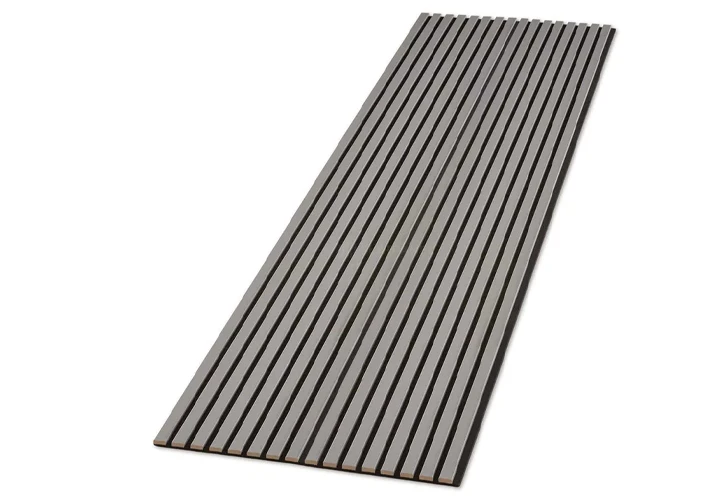
Common acoustic slat panel formats include approximately 2400 × 600 mm, although customized lengths and widths are also available depending on the manufacturer's production capabilities.
Premium products should feature:
Accurate length and width.
Consistent overall thickness.
Straight panel edges.
Clean cutting surfaces.
Minimal visible damage.
Reliable edge bonding.
Poor edge finishing can create difficulties during installation, particularly when panels are arranged in continuous wall systems.
For large commercial projects, dimensional consistency also helps contractors calculate material quantities and minimize unnecessary cutting waste.
2.4 Professional CNC Machining and Assembly
Advanced manufacturing equipment can improve product consistency and reduce human errors.
Depending on the production design, manufacturers may use CNC cutting machines, precision saws, automated positioning equipment, and specialized assembly systems.
These processes help ensure that individual slats maintain their intended dimensions and positions.
However, equipment alone does not guarantee premium quality.
The manufacturer's production standards, operator experience, maintenance procedures, and inspection systems remain equally important.
When evaluating a Chinese acoustic panel factory, international buyers should pay attention to its actual production capabilities rather than relying only on factory photographs or equipment lists.
Superior Surface Finishing Demonstrates Premium Decorative Quality
Acoustic slat panels are functional building materials, but their decorative appearance is equally important.
In many commercial applications, they are installed in highly visible locations, including hotel reception walls, office feature walls, restaurant interiors, and conference room backgrounds.
Surface finishing therefore plays a major role in determining whether a product meets premium design expectations.
3.1 Consistent Color and Texture
Premium acoustic slat panels should demonstrate consistent color and texture across individual slats and complete production batches.
Common decorative finishes include:
Natural oak.
Walnut.
Teak.
Smoked oak.
Black.
Grey wood grain.
White oak.
Custom wood-look finishes.
Color consistency is particularly important for wholesale buyers and project contractors.
Imagine ordering 500 panels for a hotel renovation. If the color varies noticeably between production batches, the finished wall may appear patchy and visually inconsistent.
A professional manufacturer should establish clear color references and production standards.
For projects requiring large quantities, buyers should consider approving a production sample before mass manufacturing begins.
They should also confirm whether all panels will be produced using the same finish specification.
3.2 Smooth and Uniform Surface Texture
A premium decorative finish should have a consistent texture without obvious bubbles, scratches, peeling, or irregular coating marks.
For wood-look acoustic panels, the printed or laminated grain pattern should also appear natural and visually balanced.
Important inspection points include:
Surface smoothness.
Uniform decorative texture.
Consistent gloss level.
Clean corners.
No visible peeling.
No obvious color contamination.
No significant scratches or dents.
These characteristics are especially important for projects involving direct lighting.
Under strong lighting, surface defects and color inconsistencies can become more noticeable.
3.3 Reliable Decorative Film or Veneer Adhesion
Depending on the product design, acoustic slats may use decorative paper, melamine finishes, PVC films, or wood veneer.
Each finish has different visual characteristics and maintenance requirements.
For example:
Melamine finishes: Commonly used for wood-look decorative surfaces, offering a consistent appearance and practical everyday maintenance.
PVC decorative films: Provide flexibility in color and texture selection, including different wood-grain effects.
Natural wood veneer: Offers authentic wood grain characteristics and a more natural decorative appearance.
Premium manufacturing requires reliable bonding between the decorative finish and the substrate.
Poor adhesion can result in bubbling, peeling, edge lifting, or premature surface deterioration.
Buyers should evaluate the finish according to the intended application and request relevant adhesion or surface performance testing where necessary.
3.4 Clean Corners and Professional Edge Details
The quality of an acoustic slat panel is not determined by its front surface alone.
The edges and corners also reveal manufacturing standards.
Premium panels should have clean cutting lines, properly finished edges, and no excessive adhesive residue.
When panels are installed in commercial interiors, these details contribute to the overall impression of workmanship.
For architects and contractors, clean edge finishing also reduces the amount of additional trimming and adjustment required during installation.
Verified Acoustic Performance Is a Core Indicator of Premium Quality
The primary functional purpose of acoustic slat panels is to improve indoor sound conditions.
This is why acoustic performance must be treated as a measurable technical characteristic rather than simply a marketing claim.
A panel may have an attractive appearance and excellent surface finishing but still provide limited acoustic benefits if its backing material and overall construction are unsuitable.
4.1 Understanding Sound Absorption
Sound absorption refers to the ability of a material or assembly to absorb sound energy rather than reflect all of it back into the room.
In interior spaces, excessive sound reflection can contribute to:
Long reverberation times.
Echoes.
Poor speech intelligibility.
Increased background noise perception.
Uncomfortable listening environments.
Acoustic slat panels help address these issues by combining decorative slats with porous acoustic backing.
When sound waves reach the panel, part of the sound energy can enter the gaps between the slats and interact with the porous backing material.
The backing helps dissipate some of this acoustic energy.
This mechanism makes acoustic slat panels particularly useful for interior spaces where speech clarity and sound comfort are important.
4.2 NRC Ratings and Acoustic Test Reports
One important indicator of acoustic product performance is the Noise Reduction Coefficient (NRC).
NRC is a single-number rating used to summarize sound absorption across selected frequencies.
It is generally expressed on a scale from 0 to 1, with higher values indicating greater average sound absorption under the applicable test method.
However, buyers should understand that NRC is not a universal guarantee of performance in every room.
The actual sound absorption of an acoustic slat panel depends on several factors:
Slat width.
Gap width.
Felt thickness.
Backing density.
Mounting method.
Air cavity depth.
Test configuration.
For example, installing a panel with an air cavity behind it may produce different results from installing the same panel directly against a solid wall.
International buyers should request acoustic test reports that identify the actual product construction and installation configuration.
Relevant testing methods may include ISO 354 for sound absorption measurements and ASTM C423 for sound absorption and sound absorption coefficients.
A reliable supplier should avoid presenting an NRC figure without explaining how it was obtained.
4.3 Sound Absorption Across Different Frequencies
Another important characteristic is frequency-dependent performance.
Sound can be divided into low-, mid-, and high-frequency ranges.
Different frequencies behave differently when they interact with interior surfaces.
Acoustic slat panels with porous backing are generally effective at absorbing certain mid- and high-frequency sounds, while low-frequency performance depends more heavily on the complete construction and available cavity depth.
For example:
Frequency range
Typical sound characteristics
Acoustic consideration
Low frequency
Bass, mechanical rumble
Often requires deeper cavities or specialized acoustic treatment
Mid frequency
Human speech, many office sounds
Important for speech-related acoustic comfort
High frequency
Sharp reflections and higher-pitched sounds
Porous backing can help absorb sound energy
For conference rooms, office meeting spaces, and educational environments, sound absorption in speech-related frequency ranges is particularly important.
A premium manufacturer should be able to provide frequency-band test data when available, instead of relying exclusively on a single NRC value.
Even a well-manufactured acoustic slat panel may not deliver its expected performance if installed incorrectly.
Common installation considerations include:
Wall substrate conditions.
Panel fixing method.
Air cavity depth.
Acoustic insulation behind the panel.
Panel coverage area.
Positioning within the room.
For example, installing acoustic slat panels over a suitable air cavity with additional mineral wool insulation may improve sound absorption, depending on the complete assembly.
However, buyers should follow the tested installation configuration whenever acoustic ratings are specified.
It is also important to clarify that sound absorption and sound insulation are different concepts.
Acoustic slat panels primarily help reduce sound reflections inside a room. They should not automatically be marketed as soundproofing products capable of preventing sound transmission between rooms.
This distinction is particularly important for commercial construction projects.
Structural Stability, Durability, and Reliable Bonding Reflect Long-Term Quality
Premium acoustic slat panels should maintain their structural integrity throughout transportation, storage, installation, and normal indoor use.
Structural defects can create significant problems for importers and project contractors because replacing defective panels after installation may involve additional labor, transportation, and project delays.
5.1 Strong Bonding Between Slats and Acoustic Felt
The decorative slats and acoustic felt must remain securely connected.
Poor bonding may cause:
Slat separation.
Felt detachment.
Uneven panel surfaces.
Localized deformation.
Installation difficulties.
A quality manufacturer should use suitable adhesives and controlled bonding procedures.
The bonding system should be compatible with the substrate, decorative finish, and acoustic backing.
Buyers can inspect samples by checking whether the slats remain firmly attached during normal handling.
For more demanding projects, relevant bonding and durability tests should be requested.
5.2 Resistance to Warping and Deformation
Dimensional stability is another important indicator of manufacturing quality.
MDF-based acoustic slat panels can be affected by excessive moisture, unsuitable storage conditions, and significant environmental changes.
Premium products should be manufactured using appropriately conditioned materials and controlled production processes.
Important considerations include:
Consistent substrate quality.
Suitable moisture content.
Proper adhesive application.
Stable panel construction.
Appropriate packaging.
Dry storage conditions.
It is important to remember that standard MDF acoustic slat panels are generally intended for indoor applications.
They should not be assumed suitable for bathrooms, outdoor installations, or persistently humid environments unless the manufacturer has developed and tested a suitable moisture-resistant construction.
5.3 Resistance to Everyday Surface Wear
In commercial environments, acoustic slat panels may experience regular contact during cleaning, furniture movement, and daily operations.
Premium decorative surfaces should have appropriate resistance to ordinary indoor wear.
Depending on the selected finish, buyers may evaluate:
Scratch resistance.
Abrasion resistance.
Stain resistance.
Surface adhesion.
Cleaning compatibility.
Color stability under indoor lighting.
These properties are particularly relevant for hotels, offices, restaurants, retail spaces, and other high-traffic environments.
However, performance varies depending on the decorative finish.
A natural wood veneer, for example, may require different maintenance procedures from a melamine or PVC decorative surface.
B2B buyers should therefore request finish-specific maintenance guidance.
5.4 Reliable Packaging and Transportation Protection
Product quality must also be maintained during international shipping.
Acoustic slat panels are relatively large decorative products, and their corners, edges, and surface finishes can be damaged if packaging is inadequate.
Professional export packaging should consider:
Protective wrapping.
Corner protection.
Suitable cartons.
Pallet protection where applicable.
Moisture protection.
Container loading arrangements.
Clear product identification.
For international importers, packaging quality is not a minor logistical detail.
It directly affects the number of products arriving in acceptable condition and can influence the overall landed cost.
A reliable Chinese factory should understand the requirements of container loading and international transportation.
Design Versatility and Installation Compatibility Demonstrate Product Value
Premium acoustic slat panels should offer more than acceptable technical performance.
They should also provide the design flexibility and installation compatibility required by modern architectural and interior design projects.
6.1 A Wide Range of Decorative Finishes
Different commercial projects have different design requirements.
A hotel may prefer warm walnut finishes to create an elegant hospitality atmosphere, while a modern office may require natural oak or darker finishes to complement its interior design.
Premium suppliers should offer multiple decorative options.
Common choices include:
Finish
Typical applications
Design characteristics
Natural Oak
Offices, hotels, meeting rooms
Bright and natural
Walnut
Hotel lobbies, reception areas
Warm and sophisticated
Teak
Hospitality and commercial interiors
Rich wood appearance
Black
Studios, restaurants, modern offices
Contemporary and dramatic
Grey Wood Grain
Corporate and retail interiors
Minimalist and neutral
White Oak
Residential developments, hotels
Clean and understated
For B2B procurement, color selection should be supported by physical samples whenever possible.
Digital photographs may not accurately represent the actual surface color under different lighting conditions.
6.2 Customizable Slat Dimensions and Panel Specifications
Different architectural applications require different panel dimensions.
Some projects may need standard acoustic slat panels, while others require customized sizes to match specific wall heights, ceiling structures, or decorative layouts.
A capable factory may offer customization options such as:
Panel length.
Panel width.
Overall thickness.
Slat width.
Slat spacing.
Decorative finish.
Acoustic felt color.
Customized packaging.
Customization is especially valuable for project contractors and wholesale distributors serving different market segments.
However, buyers should confirm the manufacturer's actual production capabilities, minimum order quantities, and additional costs before placing orders.
6.3 Easy Installation and Practical Construction
Installation efficiency is another important factor in evaluating product quality.
Professional acoustic slat panels should be designed to support straightforward installation using suitable fixing methods.
Depending on the product structure, installation may involve:
Screws and mechanical fasteners.
Suitable construction adhesive.
Installation over battens.
Fixing onto an existing wall framework.
The correct method depends on the panel specifications, wall substrate, project requirements, and acoustic performance targets.
A well-designed panel should allow contractors to achieve consistent alignment without excessive adjustment.
Manufacturers should provide clear installation instructions covering:
Wall preparation.
Measurement and positioning.
Cutting requirements.
Fixing methods.
Panel alignment.
Edge finishing.
Cleaning and maintenance.
For large commercial projects, clear installation guidance can help reduce labor costs and minimize installation errors.
6.4 Compatibility with Different Interior Design Styles
Another advantage of acoustic slat panels is their adaptability.
They can be incorporated into different interior design concepts, including:
Modern minimalist interiors.
Scandinavian-inspired spaces.
Contemporary commercial environments.
Luxury hospitality interiors.
Industrial-style offices.
Natural wood-inspired interiors.
This flexibility makes acoustic slat panels attractive to wholesalers and distributors because one product category can serve multiple customer segments.
Application Performance and Quality Control Separate Reliable Manufacturers from Ordinary Suppliers
A premium acoustic slat panel must perform consistently in its intended application.
This means buyers should evaluate not only individual product specifications but also the manufacturer's ability to maintain quality across production batches.
7.1 Performance in Office and Meeting Room Environments
Offices are among the most common applications for acoustic slat panels.
Open-plan workplaces often experience noise from conversations, telephone calls, computer equipment, and employee movement.
Excessive sound reflection can make these environments uncomfortable and reduce speech intelligibility.
Acoustic slat panels can help improve the acoustic environment when installed as part of an appropriate room treatment strategy.
Common installation locations include:
Meeting room feature walls.
Reception areas.
Office partitions.
Collaborative working spaces.
Conference room backgrounds.
For office projects, buyers should consider the total acoustic treatment area and whether additional ceiling or wall absorption is necessary.
7.2 Performance in Hotels and Hospitality Projects
Hotels require interior materials that balance appearance, durability, and practical maintenance.
Acoustic slat panels are suitable for selected interior applications such as:
Hotel reception walls.
Guest lounge areas.
Restaurant feature walls.
Meeting rooms.
Conference facilities.
Corridors and selected public spaces.
Natural wood-look finishes can complement hospitality interiors while acoustic backing helps reduce sound reflections.
For hotel procurement projects, consistency across large quantities is especially important.
A manufacturer must be able to maintain stable decorative finishes and dimensions throughout the order.
7.3 Performance in Restaurants and Commercial Spaces
Restaurants, cafes, and retail environments often contain multiple hard surfaces, including glass, tile, stone, and concrete.
These materials can contribute to excessive sound reflections.
Acoustic slat panels provide a decorative solution that can be integrated into walls to help improve sound absorption.
They are particularly useful for feature walls and selected dining areas.
However, in environments where grease, moisture, or intensive cleaning is expected, buyers should carefully evaluate whether the chosen decorative finish is appropriate.
Standard MDF acoustic panels should not be treated as waterproof products.
7.4 Factory Quality Control Procedures
A professional acoustic slat panel manufacturer should have a structured quality inspection process.
This process should cover incoming materials, production operations, finished products, and export packaging.
A typical quality control workflow includes:
Raw Material InspectionCheck MDF substrates, acoustic felt, decorative finishes, adhesives, and other incoming materials.
Production Process InspectionMonitor cutting accuracy, slat dimensions, surface treatment, bonding, and assembly.
Finished Product InspectionInspect dimensions, color consistency, surface defects, edge finishing, and structural bonding.
Performance VerificationReview relevant acoustic, environmental, and physical performance test reports.
Packaging InspectionConfirm protective packaging, product labeling, quantities, and loading arrangements.
For international buyers, these procedures help reduce the risk of receiving inconsistent or defective products.
It is also advisable to agree on inspection criteria before mass production.
7.5 Documentation and International Market Requirements
Different countries and commercial projects may have different compliance requirements.
Depending on the destination market and intended application, buyers may need documentation covering:
Formaldehyde emissions.
VOC emissions.
Acoustic absorption.
Fire performance.
Material composition.
Product dimensions.
Installation instructions.
Fire performance deserves particular attention.
MDF, decorative films, adhesives, and polyester felt can all influence the fire behavior of the finished panel.
A standard acoustic slat panel should not automatically be described as fire-rated.
For projects involving public buildings, hotels, schools, and commercial facilities, buyers should request fire test reports for the complete panel assembly under the specific standard required by the project.
For example, some European projects may specify EN 13501-1 classifications, while North American projects may require different test standards depending on building codes and application.
The test report should correspond to the actual product construction being supplied.
How to Choose a Premium Acoustic Slat Panel Manufacturer in China: AesthEdge's B2B Supply Perspective
Identifying a premium acoustic slat panel is only one part of the procurement process.
For international importers, wholesalers, distributors, and project contractors, choosing the right manufacturer is equally important.
A supplier with attractive product photographs but inconsistent manufacturing capabilities may create problems after an order is placed.
A professional factory should demonstrate product consistency, customization capabilities, technical support, and reliable export services.
8.1 Evaluate the Manufacturer's Actual Production Capabilities
When selecting a Chinese acoustic slat panel supplier, buyers should investigate its manufacturing facilities and production processes.
Important questions include:
Does the company have its own manufacturing facilities?
What materials are used for the slats and acoustic backing?
Can the factory maintain consistent dimensions across large orders?
Does it support customized colors and specifications?
What quality inspection procedures are used?
Can it provide samples before mass production?
Does it have experience handling international orders?
A factory's manufacturing capabilities are particularly important for wholesalers and distributors who need stable product quality over repeated purchases.
8.2 Request Samples Before Placing Bulk Orders
Samples allow buyers to examine the product directly rather than relying exclusively on online photographs.
When evaluating an acoustic slat panel sample, check:
Inspection item
What to look for
Slat dimensions
Uniform width and thickness
Slat spacing
Consistent and straight gaps
Surface finish
No obvious scratches or peeling
Color consistency
Stable color and wood-grain appearance
Acoustic felt
Uniform thickness and structure
Bonding
Slats securely attached to backing
Panel edges
Clean cutting and finishing
Overall construction
Flat, stable, and well assembled
For larger projects, buyers should also request samples from the intended production batch or approve a reference sample before manufacturing.
8.3 Compare Suppliers Beyond the Unit Price
Price is an important factor in international sourcing, but the lowest quotation does not necessarily represent the best purchasing decision.
A more comprehensive evaluation should consider:
Raw material specifications.
Decorative finish quality.
Acoustic test performance.
Manufacturing consistency.
Customization costs.
Minimum order quantity.
Production lead time.
Packaging standards.
After-sales support.
A slightly higher unit price may be justified if the supplier offers better dimensional consistency, more reliable packaging, and fewer quality-related problems.
For importers and distributors, these factors can have a direct impact on customer satisfaction and long-term profitability.
8.4 Why Consider AesthEdge as Your China Acoustic Slat Panel Supplier?
エースエッジ is a China-based manufacturer and supplier of decorative interior materials, serving international B2B customers seeking practical and visually appealing wall solutions.
Based in Linyi City, Shandong Province, China, AesthEdge focuses on supplying decorative wall materials for wholesalers, importers, distributors, architects, and commercial project contractors.
Our product portfolio includes:
Acoustic wall panels.
WPC fluted wall panels.
Bamboo charcoal wood veneer.
PVC marble sheets.
SPC wall panels.
Decorative interior wall materials.
For acoustic slat panel buyers, working with a professional decorative materials supplier can simplify product sourcing and help coordinate different interior wall material requirements within one procurement program.
AesthEdge focuses on several important aspects of B2B supply:
Product Selection: A range of decorative interior materials for different commercial and architectural applications.
Customization Support: Communication regarding product specifications, colors, dimensions, and project requirements, subject to product availability and manufacturing feasibility.
Factory Supply: Direct communication with a China-based manufacturing supplier for product information, quotations, and order coordination.
Sample Support: Product samples can help international buyers evaluate appearance and material characteristics before confirming bulk purchases.
Export-Oriented Service: Assistance with product information, packaging coordination, and international order requirements.
For distributors and project contractors, a reliable supplier should provide more than a quotation. Product consistency, technical communication, and dependable order execution are equally important.
8.5 Questions B2B Buyers Should Ask Before Ordering Acoustic Slat Panels
Before purchasing acoustic slat panels from a Chinese manufacturer, consider asking the following questions:
Q1: What materials are used in premium acoustic slat panels?
Most common products combine MDF or other wood-based decorative slats with polyester acoustic felt backing. Material specifications vary between manufacturers and product models.
Buyers should confirm the substrate, backing material, decorative finish, and adhesive specifications.
Q2: How can I determine whether an acoustic slat panel has good sound absorption performance?
Request an acoustic test report showing sound absorption coefficients across different frequencies and the applicable NRC value where available.
Check the test standard and mounting configuration to ensure the results correspond to the product being purchased.
Q3: Are MDF acoustic slat panels suitable for bathrooms?
Standard MDF acoustic slat panels are generally intended for indoor environments with controlled humidity.
They are not normally recommended for direct water exposure or persistently humid conditions unless specifically engineered and tested for such applications.
Q4: Can acoustic slat panels be customized?
Many manufacturers offer customization options, including slat width, panel dimensions, decorative colors, surface finishes, and backing specifications.
The available options depend on production capabilities and minimum order requirements.
Q5: What is the typical size of acoustic slat panels?
A common format is approximately 2400 × 600 mm, but actual dimensions vary by manufacturer.
Custom sizes may be available for commercial projects.
Q6: Do acoustic slat panels provide soundproofing?
Acoustic slat panels primarily absorb sound reflections within a room.
They can help reduce reverberation and improve acoustic comfort, but they do not automatically provide effective sound insulation between separate rooms.
Q7: What documents should importers request from a manufacturer?
Depending on the application and destination market, buyers should request material specifications, acoustic test reports, environmental documentation, fire performance reports where required, and installation instructions.
Q8: How should acoustic slat panels be maintained?
Maintenance depends on the decorative finish.
In general, regular dust removal and gentle cleaning with a suitable soft cloth are recommended. Buyers should avoid excessive water and aggressive cleaning chemicals unless the finish manufacturer confirms their suitability.
Q9: Can acoustic slat panels be used on ceilings?
Some acoustic slat panel systems can be installed on ceilings, provided the product construction and fixing system are suitable for overhead installation.
Additional mechanical fixing and appropriate structural support may be necessary.
Q10: Why should wholesalers purchase directly from a China factory?
Direct factory sourcing can provide better access to product specifications, customization discussions, manufacturing information, and bulk order coordination.
It can also simplify communication between buyers and the actual production supplier.
Conclusion: Premium Acoustic Slat Panel Quality Is Reflected in Every Manufacturing Detail
Premium acoustic slat panels demonstrate their quality through a combination of material selection, manufacturing precision, surface finishing, acoustic performance, structural stability, installation compatibility, and reliable quality control.
For international B2B buyers, the most important consideration is not simply whether a panel looks attractive in a product photograph.
A genuinely reliable product should maintain consistent dimensions, uniform decorative finishes, secure bonding, and verified acoustic performance under the intended installation conditions.
When selecting an acoustic slat panel manufacturer in China, importers and wholesalers should pay close attention to material specifications, factory production capabilities, sample quality, testing documentation, and export packaging standards.
エースエッジ is committed to supplying decorative interior materials for international wholesalers, distributors, and commercial project buyers.
Whether you are sourcing acoustic wall panels for hotel interiors, office meeting rooms, restaurant projects, or commercial developments, choosing a professional manufacturing supplier is an important step toward achieving consistent product quality and successful project delivery.
Looking for a reliable acoustic slat panel supplier in China?
Contact AesthEdge to discuss your product requirements, request samples, and explore suitable decorative wall solutions for your wholesale or commercial projects.






 Japanese
 English
 French
 Russian
 Spanish
 Arabic
 Portuguese