Bathrooms are among the most demanding areas in residential, commercial, and hospitality buildings. Constant exposure to water, steam, humidity, cleaning chemicals, and temperature fluctuations means that bathroom wall materials must meet higher performance standards than materials used in ordinary interior spaces. For developers, contractors, distributors, wholesalers, and building material importers, selecting the right bathroom wall covering is essential for achieving long-term durability, controlling installation costs, and maintaining an attractive interior appearance.
Traditional bathroom finishes, such as ceramic tiles, natural stone, and painted walls, have been widely used for decades. However, these materials can involve complicated installation procedures, extensive surface preparation, grout maintenance, and relatively high labor costs. As construction schedules become tighter and buyers increasingly seek materials that combine practical performance with modern aesthetics, SPC wall panels are becoming an attractive alternative.
SPC stands for Stone Plastic Composite. Painéis de parede SPC are manufactured using a rigid composite core, typically combining calcium carbonate and PVC resin, together with decorative films and protective surface layers. This structure provides dimensional stability, moisture resistance, and a durable decorative finish. Depending on the product construction, SPC bathroom wall panels can imitate marble, natural stone, concrete, wood, and other premium decorative materials.
For bathroom renovation projects, hotels, apartments, residential developments, commercial buildings, and prefabricated construction, SPC wall panels offer several practical advantages.
As a professional Chinese manufacturer and supplier of decorative wall materials, AesthEdge provides SPC wall panel solutions for international importers, wholesalers, contractors, and project buyers. This article explores the main reasons for using SPC wall panels in bathrooms, their technical advantages, installation considerations, and purchasing factors that B2B buyers should evaluate before placing bulk orders.
Excellent Waterproof Performance for Bathroom Environments
Water resistance is one of the most important reasons to choose SPC wall panels for bathrooms.
Unlike ordinary MDF panels, standard wallpaper, or conventional wood-based decorative materials, SPC wall panels are manufactured with a PVC-based composite structure that offers excellent resistance to moisture. The material itself does not absorb water in the same way as many conventional wood-based panels, making it suitable for interior environments where humidity and occasional water splashes are common.
Bathrooms experience several types of moisture exposure:
Direct water splashes around washbasins.
Steam generated by hot showers and bathtubs.
High humidity caused by inadequate ventilation.
Condensation on walls and other cold surfaces.
Frequent cleaning with water and household detergents.
These conditions can gradually damage unsuitable wall coverings. Wood-based materials may swell, wallpaper may peel, and painted surfaces may deteriorate when exposed to persistent moisture.
SPC bathroom wall panels provide a more moisture-resistant decorative solution.
Why Does SPC Perform Well in Wet Environments?
The waterproof characteristics of SPC panels come primarily from their composite core. PVC resin provides water resistance, while mineral fillers contribute rigidity and dimensional stability. The decorative surface and protective coating add another functional layer to the finished product.
Unlike ceramic tile installations, SPC panels can also reduce the number of joints across a wall when large-format panels are used. Fewer joints mean fewer areas that require sealing and routine maintenance.
However, buyers should understand an important technical distinction: waterproof panel material does not automatically make an entire bathroom waterproof.
The waterproof performance of the finished wall system also depends on:
Correct installation procedures.
Appropriate joint sealing.
Suitable adhesives and installation accessories.
Proper treatment of corners and wall penetrations.
Effective waterproofing behind the panels where required.
Adequate bathroom ventilation.
For shower enclosures and other areas with continuous direct water exposure, the complete installation system must be designed and approved for wet-area use.
Suitable Bathroom Applications
SPC wall panels can be used in various bathroom areas, depending on the product specifications and installation system.
Shower walls: Suitable for products specifically approved for shower applications, with properly sealed joints and corners.
Washbasin backgrounds: Help protect decorative walls from daily splashes.
Bathtub surrounds: Create a continuous decorative finish around bathtubs.
Hotel bathrooms: Provide a consistent appearance across multiple guest rooms.
Apartment bathrooms: Offer a practical decorative solution for large residential developments.
For overseas buyers, waterproof performance should be one of the first specifications to verify when comparing SPC wall panel suppliers.
AesthEdge offers decorative SPC wall panel solutions designed for modern interior applications, allowing project buyers to select different finishes according to their bathroom design requirements.
Resistance to Mold, Moisture-Related Damage, and Daily Wear
Another important reason for using SPC wall panels in bathrooms is their ability to withstand demanding indoor conditions.
Bathrooms are naturally humid environments. Without appropriate ventilation and moisture management, walls may develop mold, mildew, and other moisture-related problems.
Although no wall covering can eliminate mold throughout a building, choosing moisture-resistant materials can help reduce some of the conditions that contribute to material deterioration.
Reduced Risk of Water Absorption and Swelling
One common problem with conventional decorative wall materials is water absorption.
When moisture penetrates wood-based boards, the material may swell, lose its shape, or experience surface damage. Repeated exposure can shorten the service life of the installation.
SPC wall panels have a rigid composite core that is less susceptible to moisture-related swelling than conventional untreated wood-based panels.
This characteristic makes them suitable for bathroom renovation projects where long-term appearance and dimensional stability are important.
Easier Cleaning and Surface Maintenance
Bathroom walls are exposed to soap residue, toothpaste, shampoo, cosmetics, and everyday dirt.
A well-finished SPC wall panel generally has a smooth, non-porous decorative surface that can be cleaned using a soft cloth and suitable mild cleaning products.
Compared with traditional tiled walls, large-format SPC panels may also reduce the amount of grout maintenance required.
For hotel operators, apartment management companies, and commercial property owners, this can help simplify routine cleaning procedures.
Resistance to Everyday Surface Wear
Depending on the decorative film and protective coating, SPC wall panels can offer resistance to common indoor surface wear, including:
Routine wiping and cleaning.
Minor surface scratches.
Everyday contact and abrasion.
Normal household use.
Common bathroom cleaning activities.
However, resistance levels vary by product construction. Buyers should request technical specifications and sample testing rather than assuming that all SPC wall panels have identical performance.
An Important Point About Mold Prevention
SPC materials are generally less vulnerable to moisture absorption than many wood-based decorative boards. Nevertheless, mold can still grow on accumulated soap residue, dust, sealants, or other organic materials if surfaces remain wet and ventilation is inadequate.
For this reason, a complete bathroom solution should combine moisture-resistant wall panels with proper waterproofing, ventilation, and installation quality.
For B2B buyers, these factors are important when evaluating the long-term suitability of SPC bathroom wall panels for hotels, apartments, and commercial projects.
Modern Marble Designs and Flexible Interior Decoration Options
Bathroom design is no longer limited to plain white tiles or conventional ceramic finishes. Developers, hotel designers, architects, and homeowners increasingly prefer bathrooms that combine practical functionality with attractive decorative details.
SPC wall panels offer considerable design flexibility, making them suitable for contemporary, minimalist, luxury, and natural-inspired bathroom interiors.
One of the biggest advantages is the ability to reproduce the appearance of premium materials without requiring the same installation approach as natural stone.
Popular SPC Bathroom Wall Panel Designs
Different decorative films allow SPC panels to imitate a wide range of surface textures and colors.
Common choices include:
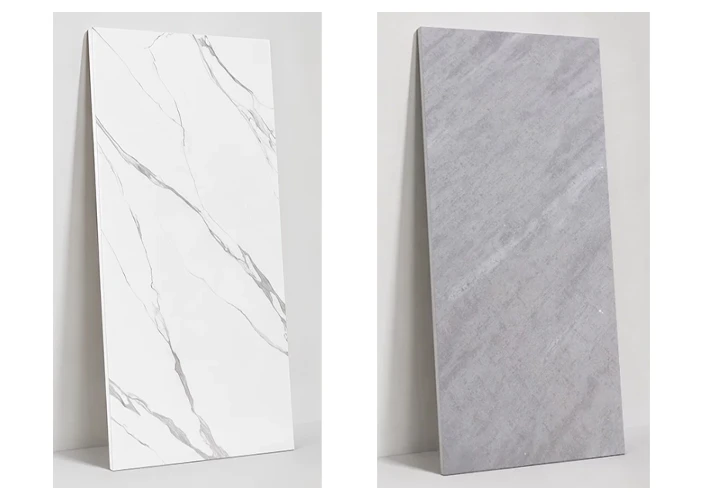
White Carrara marble patterns.
Calacatta marble designs.
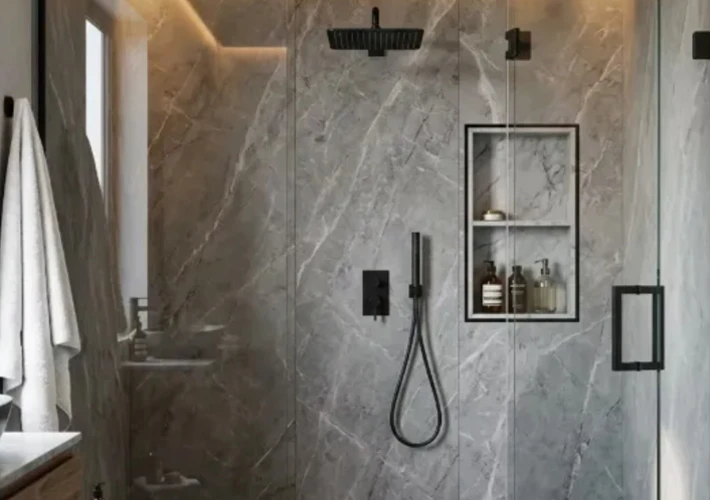
Grey marble textures.
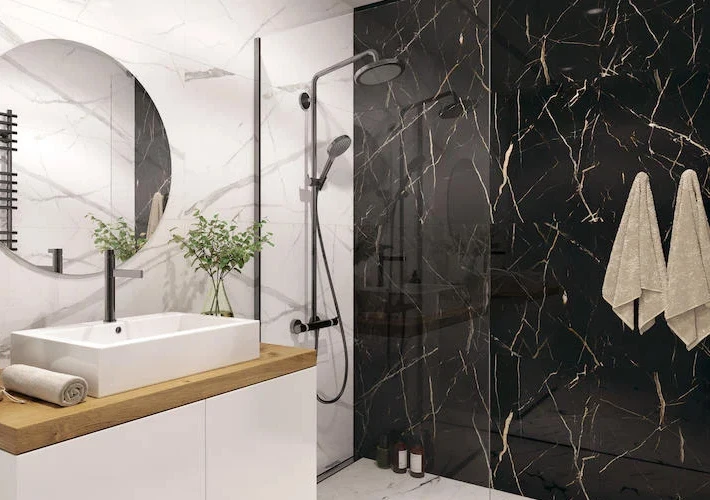
Black marble finishes.
Beige travertine-inspired patterns.
Natural stone effects.
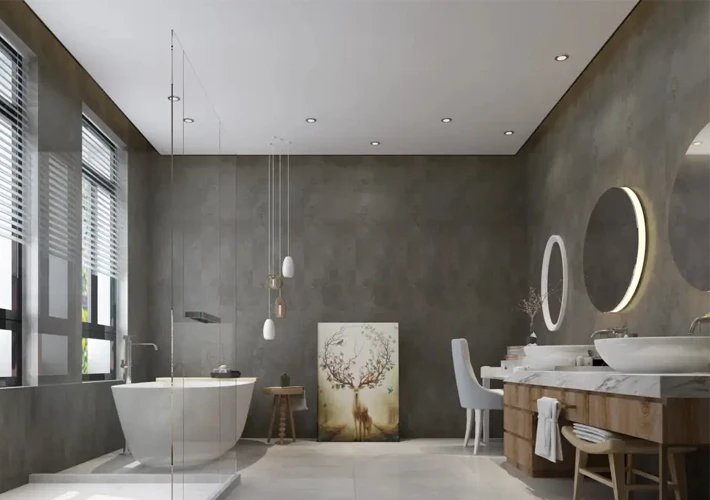
Concrete-style finishes.
Light oak and wood-inspired patterns.
Minimalist solid colors.
These options help project buyers coordinate wall finishes with bathroom cabinets, sanitary ware, flooring, mirrors, lighting, and metal accessories.
Marble-Look SPC Panels for Luxury Bathrooms
Marble-effect SPC wall panels are particularly popular in hotel bathrooms, luxury apartments, serviced residences, and upscale residential developments.
White marble designs can make smaller bathrooms appear brighter and more spacious. Grey marble patterns create a sophisticated contemporary atmosphere, while beige and cream stone designs provide a warmer and more welcoming appearance.
Large-format panels can also create a more continuous visual effect by reducing the number of visible joints.
For example, a hotel bathroom can use large marble-look SPC panels across the shower area and washbasin wall to establish a consistent decorative theme.
Large-Format Panels for Seamless Visual Effects
Panel dimensions are an important consideration when planning bathroom interiors.
Large-format SPC wall panels are often preferred for feature walls and spacious bathroom installations because they can reduce visible joint lines and create a cleaner appearance.
Smaller panel formats may be more practical for compact spaces, complex layouts, or specific decorative arrangements.
When selecting dimensions, buyers should consider:
Bathroom wall height and width.
Door and window positions.
Shower enclosure dimensions.
Transportation and handling requirements.
Installation equipment.
Cutting and material waste.
Customization for Commercial Projects
For distributors and project contractors, product customization can provide an important competitive advantage.
Depending on manufacturing capabilities and minimum order quantities, SPC wall panel manufacturers may offer different:
Decorative patterns.
Surface textures.
Panel dimensions.
Thickness options.
Edge profiles.
Packaging specifications.
At AesthEdge, we understand that different international markets have different preferences regarding bathroom colors, marble patterns, and decorative styles. Offering a suitable selection of finishes helps importers and distributors serve different customer segments.
For buyers developing hotel projects or residential communities, consistent decorative designs across multiple bathrooms can also simplify material selection and project management.
Faster Installation and Lower Overall Project Costs
Installation efficiency is another major reason why contractors and developers consider SPC wall panels for bathroom applications.
Traditional ceramic tile installation involves several procedures, including surface preparation, adhesive application, tile positioning, spacing, cutting, grouting, and cleaning.
Natural stone installations may require additional handling and structural considerations because of the weight of the material.
SPC wall panels can simplify certain parts of the installation process, particularly when large-format panels are used.
A More Efficient Installation Process
Depending on the product design and installation system, SPC wall panels may be installed using compatible construction adhesives, mechanical fixing systems, or manufacturer-recommended installation accessories.
A typical installation process includes:
Inspecting the existing wall and checking its condition.
Confirming that the substrate is sufficiently stable, flat, and dry.
Completing necessary waterproofing and substrate preparation.
Measuring the wall and planning panel layouts.
Cutting the panels to the required dimensions.
Applying the specified adhesive or fixing system.
Positioning and securing the panels.
Sealing joints, corners, and other critical areas.
Inspecting the completed installation.
The exact installation method depends on panel specifications, substrate conditions, and the intended wet-area application.
Potential Savings in Labor Costs
For commercial construction projects, labor costs can represent a significant portion of the total interior finishing budget.
SPC wall panels may reduce installation time compared with traditional tile systems in suitable applications because they can cover relatively large wall areas with fewer individual pieces.
Potential advantages include:
Fewer individual wall covering units.
Reduced grout-related procedures.
Efficient coverage of large wall surfaces.
Less complicated decorative layout work for standard designs.
Potentially shorter renovation schedules.
However, actual savings depend on the installation system, site conditions, panel dimensions, installer experience, and local labor rates.
Buyers should compare the complete installed cost rather than simply comparing the purchase price per square meter.
Reducing Renovation Disruption
In hotels, apartments, and commercial buildings, renovation time directly affects project schedules and business operations.
A faster wall finishing process may help contractors complete bathroom upgrades more efficiently.
For hotels, shorter renovation periods can reduce room downtime. For apartment developers, efficient installation can support more predictable construction schedules.
Understanding the Total Cost of Ownership
B2B buyers should evaluate SPC wall panels based on their total project cost.
A practical cost comparison should include:
Cost Factor
Painéis Murais SPC
Traditional Ceramic Tiles
Material purchase
Depends on panel specification and finish
Depends on tile material and design
Installation labor
May be lower in suitable applications
Often involves multiple installation stages
Joint treatment
Fewer joints with large-format panels
Grouting is generally required
Installation time
Potentially faster
Depends on tile size and layout
Manutenção
Generally straightforward surface cleaning
Grout may require additional maintenance
Transportation
Relatively lightweight compared with many stone products
Varies by tile type and thickness
The table provides a general comparison rather than a guaranteed cost ranking. Actual costs should be calculated using local installation rates and product specifications.
For importers, wholesalers, and contractors, the most competitive bathroom wall solution is not necessarily the product with the lowest factory price. It is the product that provides the right balance of material quality, installation efficiency, appearance, and long-term performance.
Lightweight Construction, Convenient Transportation, and Wide Applications
Weight is an important factor in modern interior construction.
Natural stone and some traditional wall finishing materials can be relatively heavy, creating additional handling and transportation requirements.
SPC wall panels generally offer a lighter alternative to many natural stone finishes, although actual weight depends on panel thickness, density, dimensions, and construction.
Advantages of Lightweight Panels
The relatively manageable weight of SPC wall panels can offer several practical benefits:
Easier handling during transportation.
More convenient on-site material movement.
Simplified cutting and positioning.
Reduced handling requirements compared with many heavy stone products.
Greater flexibility for selected renovation projects.
However, buyers should not assume that SPC panels can be installed over every existing wall without preparation.
The supporting substrate must still meet the manufacturer's requirements for flatness, strength, cleanliness, and stability.
Suitable for New Construction and Renovation
SPC bathroom wall panels can be considered for both new construction and renovation projects.
For new buildings, contractors can incorporate the panels into the interior finishing schedule from the beginning.
For renovation projects, SPC panels may provide an alternative to removing and replacing existing decorative wall finishes, provided the existing substrate is suitable and the installation system permits it.
Before renovation, contractors should inspect:
Existing wall stability.
Signs of water leakage.
Mold or moisture damage.
Surface flatness.
Existing tile adhesion.
Waterproofing conditions.
Installing new panels over an unsuitable substrate may lead to installation failure, even when the panels themselves have good material properties.
Applications Across Different Building Types
The flexibility of SPC wall panels makes them relevant to several commercial and residential segments.
1. Hotels and Resorts
Hotel bathrooms require attractive finishes that can be repeated across multiple guest rooms.
SPC marble-look wall panels can help establish a consistent decorative appearance while offering practical cleaning and maintenance characteristics.
2. Apartments and Residential Developments
Developers can use different SPC panel designs to create modern bathroom interiors across large residential projects.
Standardized patterns and panel dimensions can also simplify bulk purchasing.
SPC panels can be considered for washbasin backgrounds, bathroom feature walls, and suitable shower areas.
4. Office and Commercial Buildings
Commercial washrooms often prioritize durability, maintenance efficiency, and consistent interior design.
SPC panels offer a range of decorative options for these environments.
5. Prefabricated and Modular Buildings
Lightweight decorative wall materials can be useful in selected prefabricated construction projects.
SPC wall panels can provide a finished decorative surface for modular bathroom interiors, subject to the requirements of the building system.
How SPC Wall Panels Compare with Ceramic Tiles, PVC Panels, and Natural Stone
When choosing bathroom wall materials, B2B buyers should understand how SPC compares with other available options.
Each material has its own strengths, limitations, and ideal application scenarios.
SPC Wall Panels vs. Ceramic Tiles
Ceramic tiles are one of the most established bathroom wall materials.
They offer excellent durability, a wide selection of finishes, and proven performance in wet environments when installed correctly.
However, tile installation generally requires multiple individual pieces, adhesive, grout, and careful joint treatment.
SPC wall panels may provide a more efficient decorative solution for projects that prioritize large-format finishes and installation speed.
Comparison
Painéis Murais SPC
Ceramic Tiles
Water resistance
Excellent material-level moisture resistance
Excellent when correctly installed
Joint quantity
Can be reduced with large panels
Generally more joints
Instalação
Often relatively straightforward
Requires tile positioning and grouting
Decorative options
Marble, stone, wood, and other designs
Extensive colors and textures
Weight
Generally lighter than many tile and stone options
Varies by tile type
Manutenção
Smooth surface is generally easy to clean
Grout may require additional attention
Ceramic tiles remain a strong choice for many bathrooms, particularly where traditional tile aesthetics or specific technical standards are required.
SPC panels are an alternative for buyers seeking a different combination of decorative appearance, installation efficiency, and maintenance characteristics.
SPC Wall Panels vs. Ordinary PVC Wall Panels
Both SPC and conventional PVC wall panels are plastic-based decorative wall materials, but their core compositions differ.
SPC panels typically contain a higher proportion of mineral filler combined with PVC resin, creating a relatively rigid and dimensionally stable composite structure.
Conventional PVC wall panels may have different formulations, including hollow or lightweight constructions.
Key differences include:
Core composition.
Panel rigidity.
Impact performance.
Dimensional stability.
Weight.
Surface finishing options.
The actual performance of either product depends on its manufacturing quality and construction.
For buyers comparing suppliers, it is important to review technical specifications rather than relying only on product names.
SPC Wall Panels vs. Natural Marble
Natural marble is a premium building material associated with luxury interiors.
Its natural veining and unique appearance make it desirable for upscale hotels and residential projects.
However, natural marble can involve higher material costs, heavier transportation requirements, more complicated handling, and additional maintenance.
SPC marble-look panels offer a decorative alternative for projects that want a stone-inspired appearance without using full natural stone slabs.
Comparison
SPC Marble-Look Panels
Natural Marble
Aparência
Printed or decorative stone patterns
Natural mineral patterns
Weight
Generally lighter
Relatively heavy
Water absorption
Low for the SPC core
Depends on stone type and treatment
Manutenção
Generally straightforward
May require sealing and specialized care
Instalação
Panel-based installation
Requires stone installation procedures
Pattern consistency
More controllable across batches
Natural variation
For commercial projects with strict budgets and repeated bathroom designs, SPC marble-look panels can be an attractive alternative.
Nevertheless, buyers should recognize that decorative SPC panels do not have the same natural material characteristics as genuine marble.
What Should B2B Buyers Check Before Purchasing SPC Bathroom Wall Panels?
Selecting the right SPC wall panel supplier is just as important as selecting the right product.
For importers, distributors, wholesalers, and project contractors, product quality, technical consistency, factory capabilities, and delivery reliability all influence the success of a purchasing decision.
Here are the most important factors to evaluate before placing an order.
Do not assume that thicker panels are automatically better. The correct specification depends on the intended application and installation system.
2. Surface Quality and Decorative Film
The decorative surface determines the visual quality of the finished bathroom.
Before purchasing, inspect:
Color consistency.
Pattern clarity.
Surface texture.
Printing quality.
Scratch resistance.
Protective coating performance.
For marble-look SPC wall panels, buyers should also check pattern variation and whether the manufacturer can provide coordinated designs for larger projects.
3. Waterproof and Wet-Area Suitability
Water resistance is essential, but the intended application must be clearly defined.
Ask the manufacturer whether the selected panel and its complete installation system are suitable for:
Bathroom walls.
Washbasin backgrounds.
Bathtub surrounds.
Shower walls.
Other wet-area applications.
Request technical documentation covering panel performance and recommended installation procedures.
4. Fire Performance and Environmental Documentation
Different markets have different requirements for interior decorative materials.
Importers should check whether the product meets applicable fire performance requirements and whether supporting test reports are available.
Environmental documentation may also be required for projects involving hotels, public buildings, and commercial developments.
Depending on the destination market and project specifications, buyers may request:
Fire classification reports.
VOC emission test reports.
Material safety documentation.
Environmental declarations.
Relevant quality management certifications.
Requirements vary by country and project. Buyers should verify the applicable standards instead of assuming that one certificate is valid in every market.
5. Factory Production Capacity and Quality Control
A reliable supplier should have a clear production process and quality inspection procedures.
For bulk purchasing, buyers should evaluate:
Raw material inspection.
Core production consistency.
Decorative film quality.
Surface finishing.
Dimensional inspection.
Finished product inspection.
Packaging procedures.
A factory with stable production capabilities can help distributors maintain product consistency when placing repeat orders.
6. Customization and OEM/ODM Services
For wholesalers and importers, product differentiation is important.
A manufacturer that supports customization can help buyers develop product ranges suited to their target markets.
Potential customization options include:
Marble and stone patterns.
Surface textures.
Panel sizes.
Thickness options.
Private-label packaging.
Product branding.
Customized product specifications.
Before confirming an order, buyers should clarify the minimum order quantity, sample approval procedure, production lead time, and customization costs.
7. Packaging and International Shipping
SPC wall panels must be properly protected during transportation.
For international shipments, packaging quality is particularly important because panels may experience repeated handling, container movement, and long-distance transportation.
Ask the supplier about:
Individual panel protection.
Protective corner materials.
Carton specifications.
Pallet options.
Container loading plans.
Product labeling.
Shipping documentation.
Professional packaging helps reduce the risk of surface scratches, edge damage, and other transportation-related problems.
8. Sample Evaluation Before Bulk Orders
Ordering samples is one of the most effective ways to evaluate a new SPC wall panel supplier.
Buyers should inspect the actual product rather than making decisions based only on website photographs.
A sample evaluation should cover:
Surface appearance.
Color accuracy.
Panel rigidity.
Edge quality.
Thickness consistency.
Decorative film adhesion.
Installation compatibility.
For large commercial projects, it is also advisable to conduct installation trials using the specified adhesive, joint sealant, and substrate system.
As an experienced Chinese decorative wall material supplier, AesthEdge supports international B2B buyers with product selection, decorative design options, samples, and bulk supply discussions.
Why Choose AesthEdge as Your SPC Wall Panel Supplier in China?
For international buyers, sourcing directly from a Chinese factory can provide advantages in product selection, manufacturing coordination, customization, and bulk purchasing.
However, selecting the right factory requires more than comparing quotations.
A professional supplier should understand the practical requirements of international construction projects and provide products that match the buyer's market positioning.
AesthEdge is a China-based decorative interior materials supplier focused on providing product solutions for importers, wholesalers, distributors, architects, and project contractors.
Our product portfolio includes different interior decorative materials, helping customers coordinate wall finishes and related building materials for residential, hospitality, and commercial projects.
AesthEdge Supply Advantages
1. Diverse Decorative Wall Material Selection
We provide different decorative wall material options, including SPC wall panels, WPC wall panels, PVC marble sheets, bamboo charcoal wood veneer, and acoustic panels.
This allows buyers to explore different product categories through one supplier.
2. Multiple Design and Surface Options
Different markets have different preferences for marble patterns, colors, textures, and decorative finishes.
AesthEdge supports product selection based on project requirements and target market preferences.
3. B2B Wholesale and Project Supply
We focus on serving professional buyers, including:
Building material importers.
Wholesale distributors.
Interior decoration companies.
Hotel contractors.
Real estate developers.
Architects and interior designers.
Construction material retailers.
Our objective is to support customers with suitable products for repeat distribution and commercial project requirements.
4. Factory-Oriented Supply and Customization
As a Chinese factory supplier, we understand the importance of product consistency, manufacturing coordination, and bulk order management.
Buyers can discuss product specifications, decorative options, packaging requirements, and potential OEM/ODM cooperation according to their order needs.
5. Support for International Markets
AesthEdge works with international B2B buyers seeking decorative interior materials for different market segments.
Whether you are sourcing SPC bathroom wall panels for a hotel renovation, a residential development, or wholesale distribution, selecting the right product specifications is essential.
Frequently Asked Questions About SPC Bathroom Wall Panels
Q1: Are SPC wall panels suitable for bathrooms?
Yes. SPC wall panels are suitable for many bathroom wall applications because their PVC-based composite core offers excellent moisture resistance. They can be used around washbasins, bathtubs, and other bathroom walls. Shower applications require panels and installation systems specifically approved for continuous wet-area exposure.
Q2: Are SPC bathroom wall panels completely waterproof?
The SPC panel material itself has excellent water resistance. However, the finished wall system depends on proper installation, joint sealing, corner treatment, and appropriate waterproofing behind the panels where required. Waterproof material alone does not guarantee a waterproof bathroom.
Q3: Can SPC wall panels be installed over existing bathroom tiles?
In some renovation projects, SPC panels can be installed over existing tiles if the tiles are firmly attached, the substrate is stable, and the surface meets the manufacturer's flatness and installation requirements. Loose tiles, water damage, and structural problems must be addressed first.
Q4: Do SPC bathroom wall panels develop mold?
SPC panels are less susceptible to moisture absorption than many wood-based decorative materials. Their smooth surfaces are also generally easy to clean. However, mold may still develop on dirt, soap residue, sealants, or other surfaces if moisture remains trapped. Proper ventilation and routine cleaning are important.
Q5: Are SPC wall panels better than ceramic tiles for bathrooms?
Neither material is universally better. SPC wall panels can offer advantages in installation efficiency, large-format decorative designs, and reduced grout maintenance. Ceramic tiles offer established durability and extensive design choices. The best option depends on the project budget, installation conditions, and performance requirements.
Q6: Can SPC wall panels be used inside shower areas?
Some SPC wall panel systems are suitable for shower walls, provided the manufacturer approves the product for this application and the installation system includes appropriate waterproofing and sealing. Buyers should confirm the technical specifications before using any panel in a continuously wet environment.
Q7: Are SPC marble wall panels suitable for hotels?
Yes. SPC marble-look wall panels can be used in suitable hotel bathroom applications. Their consistent decorative patterns, range of finishes, and relatively straightforward surface maintenance make them worth considering for hotel renovation and new construction projects.
Q8: How long do SPC bathroom wall panels last?
The service life depends on product quality, core construction, surface protection, installation quality, ventilation, and maintenance. Buyers should request product-specific durability information and warranty terms rather than relying on a universal lifespan estimate.
Q9: Are SPC wall panels environmentally friendly?
Environmental performance depends on the raw materials, formulation, manufacturing process, emissions, and recyclability of the finished product. Buyers should request relevant VOC emission reports and environmental documentation when these factors are important to their projects.
Q10: What should importers consider when buying SPC wall panels in bulk?
Importers should evaluate panel thickness, core composition, surface quality, decorative options, wet-area suitability, certifications, factory capacity, MOQ, lead time, packaging, and shipping arrangements. Ordering samples before confirming a container order is also recommended.
Conclusion: SPC Wall Panels Are a Practical Choice for Modern Bathroom Projects
The growing demand for efficient, attractive, and moisture-resistant interior materials has created new opportunities for SPC bathroom wall panels in international construction and renovation markets.
Their key advantages include excellent moisture resistance, a rigid composite structure, easy-to-clean decorative surfaces, flexible marble and stone designs, relatively lightweight construction, and potentially efficient installation.
For hotels, apartments, residential developments, commercial buildings, and bathroom renovation projects, SPC wall panels offer a practical alternative to some traditional wall finishing materials.
However, successful application depends on choosing the right product specifications and ensuring that the complete installation system is suitable for the intended wet-area environment.
For importers, wholesalers, and project contractors, working with a professional manufacturer is essential for maintaining product quality and ensuring stable bulk supply.
AesthEdge is committed to providing decorative wall material solutions for international B2B customers. If you are looking for a reliable SPC wall panel supplier in China, contact our team to discuss product specifications, decorative options, samples, and wholesale cooperation.



 Portuguese
 English
 French
 Russian
 Spanish
 Arabic
 Japanese