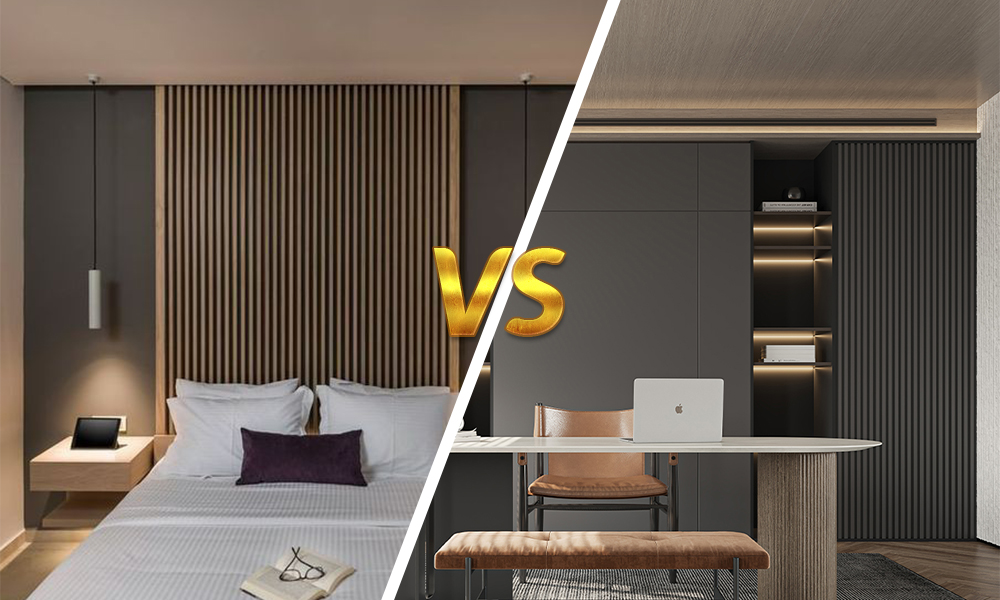
WPC wall panels and acoustic panels are designed to solve different interior design problems. WPC wall panels are primarily selected for decorative performance, durability, moisture resistance, and low maintenance, while acoustic panels are specifically designed to absorb sound and reduce echo. Therefore, the better option depends on the main requirement of the project: choose WPC wall panels when appearance, durability, and moisture resistance are the priorities; choose acoustic panels when sound absorption and acoustic comfort are the primary goals.
For commercial projects, the two materials do not necessarily have to compete with each other. In many interior spaces, WPC wall panels can be used as the main decorative wall finish, while acoustic panels can be strategically installed in areas where noise control is important. This combination allows designers, contractors, and wholesale buyers to balance aesthetics, durability, and acoustic performance.
No domínio da construção e do design de interiores, a seleção do material de parede adequado é crucial para a funcionalidade, a estética e o conforto. Os painéis de parede WPC (Wood Plastic Composite) e os painéis acústicos são duas opções predominantes, cada uma atendendo a diferentes necessidades. Esta comparação detalhada fornecerá aos clientes grossistas uma visão aprofundada das vantagens, aplicações e caraterísticas únicas de ambos os materiais.
Painéis de parede WPC: Uma visão global para clientes grossistas

Composição do material
Os painéis de parede WPC são concebidos a partir de uma combinação de aproximadamente 60-70% de fibras de madeira e 30-40% de termoplásticos, principalmente PVC ou polietileno. Esta estrutura composta fornece:
Funcionalidade e desempenho
Durabilidade: Os painéis WPC são inerentemente resistentes a:
Manutenção:
Apelo estético:
Aplicações
Utilização residencial:
Utilização comercial:
Apelo ao mercado:
Considerações sobre os custos
Investimento:
For projects where wall appearance and long-term usability are more important than dedicated sound absorption, WPC wall panels can offer several practical advantages. Their composite construction is designed to provide a more stable and lower-maintenance alternative to conventional wood-based wall finishes in suitable applications.
The key advantages of WPC wall panels include:
For wholesale buyers, the most important point is that WPC wall panels should be evaluated according to the actual product specification rather than assuming that every WPC panel has identical performance. Thickness, core formulation, surface treatment, installation method, and test reports can all affect final performance.
Painéis acústicos: Uma visão global para clientes grossistas

Composição do material
Os painéis acústicos são fabricados a partir de vários materiais de absorção de som, incluindo:
Funcionalidade e desempenho
Absorção de som:
Flexibilidade de instalação:
Variedade:
Aplicações
Espaços comerciais:
Estabelecimentos de ensino:
Ambientes criativos:
Considerações sobre os custos
Flexibilidade orçamental:
WPC wall panels and acoustic panels should not normally be considered direct substitutes because their primary performance objectives are different. WPC wall panels are mainly decorative wall finishing materials, whereas acoustic panels are primarily functional materials for controlling sound within a room.
An acoustic panel is normally selected when a project has problems such as excessive reverberation, echo, poor speech intelligibility, or uncomfortable background noise. Acoustic products are commonly evaluated using acoustic performance data such as the Noise Reduction Coefficient (NRC), depending on the product and testing method.
WPC wall panels, in contrast, are generally selected when the project requires an attractive wall surface combined with durability, easy maintenance, and design flexibility.
This distinction is particularly important for architects, contractors, and distributors. A decorative WPC wall panel should not automatically be marketed as an acoustic treatment unless the specific product has been tested and documented for acoustic performance.

The main difference between WPC wall panels and acoustic panels is their primary function. WPC wall panels are mainly decorative wall finishing products, while acoustic panels are engineered to improve the acoustic environment of a room.
| Caraterística | Painéis de parede WPC | Painéis acústicos |
|---|---|---|
| Primary purpose | Wall decoration and surface protection | Sound absorption and noise control |
| Main benefit | Durability and aesthetic flexibility | Acoustic comfort and echo reduction |
| Moisture resistance | Generally suitable for moisture-prone applications depending on product specification | Depends heavily on the panel material and construction |
| Sound absorption | Not normally the primary function | Core function |
| Design options | Wide range of colors, textures, and wood-look finishes | Wide range of colors, fabrics, shapes, and patterns |
| Manutenção | Generally easy to clean | Depends on the surface material |
| Typical applications | Feature walls, residential interiors, retail, offices, commercial interiors | Offices, classrooms, restaurants, studios, theaters |
| Best suited for | Projects prioritizing appearance and durability | Projects prioritizing acoustic performance |
| Customization | Dimensions, profiles, colors, and finishes may be customized | Shapes, sizes, colors, and configurations can often be customized |
| Wholesale consideration | Focus on surface finish, dimensions, durability, MOQ, and customization | Focus on acoustic performance, NRC, material, dimensions, and installation system |
For wholesale buyers, selecting wall panels involves more than comparing the price per square meter. Product specifications, packaging, customization, quality consistency, and supplier capability can have a significant impact on the final project cost.
Before placing a bulk order, buyers should evaluate the following factors:
Ask the manufacturer for the product structure, core material, surface finish, and available thicknesses. For WPC panels, the formulation and manufacturing process can influence dimensional stability, surface quality, and durability.
Confirm panel length, width, thickness, weight per piece, and coverage per carton. Standard dimensions can simplify installation and shipping, while customized dimensions may be useful for specific projects.
For decorative projects, request physical samples to check color consistency, texture, embossing, and surface appearance. Digital images cannot always represent the actual finish accurately.
If moisture resistance, fire performance, acoustic performance, or other technical properties are important to the project, buyers should request the relevant test reports or technical documentation from the supplier.
For international wholesale orders, packaging is an important consideration. Strong protective packaging can help reduce damage during handling and ocean transportation. Buyers should also confirm carton dimensions, quantity per carton, and container loading capacity.
Importers and distributors should confirm the minimum order quantity, available colors, customized sizes, private labeling, and OEM/ODM options before ordering.
A reliable supplier should be able to provide consistent product quality, stable production capacity, clear specifications, quality inspection, export packaging, and responsive technical support.
For distributors building a long-term product line, supplier stability is often more important than choosing the lowest initial unit price.
Neither product is universally better. WPC wall panels are generally better for decorative wall applications where durability, moisture resistance, low maintenance, and design flexibility are priorities. Acoustic panels are better when sound absorption and acoustic comfort are the main requirements.
WPC wall panels should not automatically be considered soundproofing products. Soundproofing and sound absorption are different concepts. Unless a WPC wall panel has been specifically tested and rated for acoustic performance, it should primarily be treated as a decorative wall product rather than a dedicated acoustic solution.
Yes. Combining the two can be an effective approach in offices, restaurants, hotels, retail spaces, and other commercial interiors. WPC panels can provide the main decorative finish, while acoustic panels can be installed strategically in areas where sound absorption is required.
It depends on the office design requirements. WPC wall panels are suitable for reception areas, feature walls, corridors, and decorative spaces. Acoustic panels are more useful in meeting rooms, open-plan offices, and other areas where excessive reverberation or background noise affects comfort and communication.
WPC wall panels are generally designed for relatively easy routine cleaning and maintenance. Acoustic panel maintenance depends on the facing material, such as fabric, PET, foam, fiberglass, or other construction. Buyers should check the manufacturer's cleaning and maintenance recommendations.
Importers should ask about material composition, dimensions, thickness, surface finish, technical specifications, test reports, MOQ, customization options, packaging, container loading, production capacity, lead time, and quality control procedures. Requesting physical samples before a bulk order is also recommended.
Os painéis de parede WPC e os painéis acústicos oferecem vantagens distintas adaptadas às necessidades específicas do mercado. Os painéis WPC brilham pela sua durabilidade e flexibilidade estética, enquanto os painéis acústicos são indispensáveis para a gestão do som. Compreender estas nuances permite aos clientes grossistas tomar decisões informadas e alinhadas com os seus objectivos de projeto. Para mais informações ou para solicitar amostras, contacte a nossa equipa experiente para obter assistência!